As as the Globe40 race sets off from Sydney today, Rupert Holmes reports from the half-way stage of the double-handed round the world race in Class40s
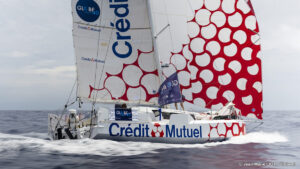
We are deep in the South Atlantic on a screaming reach, riding the leading edge of the semi-permanent cold front that extends thousands of miles south east from Brazil’s Cabo Frio.
Boat speed is peaking at 18-19 knots and we’re violently slamming into the waves ahead that engulf the entire vessel with spray and, occasionally, solid water.
Eventually the front will move northwards and pass over us, but in the meantime we’re making excellent progress towards the east south east, ahead of rounding the Cape of Good Hope.
This is the second leg of the Globe40 – a mammoth voyage in which we will cover almost 8,000 miles, from Mindelo in the Cape Verde islands to the French island of Reunion in the Indian Ocean.
Given those huge distances, the rapid progress our Class 40 Jangada 40 is making is welcome, despite the discomfort it brings.
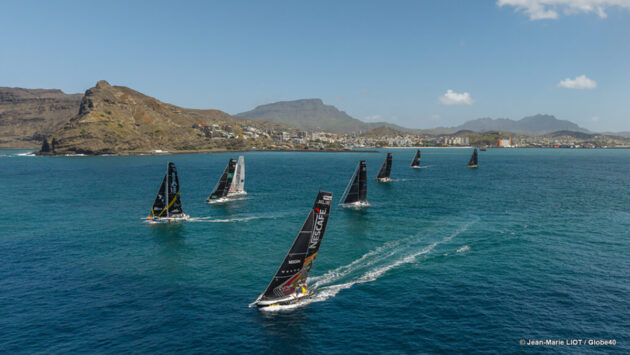
The Globe40 fleet at the start of Leg 2 in Mindelo. Photo Jean-Marie Liot/Globe40
Life on a runaway train
How long will the sleigh ride last? That’s frustratingly difficult to predict. However much data we analyse, and however long we pore over the latest satellite images of cloud formations, it’s impossible to determine with any useful level of accuracy when the massive wind shift associated with the front will reach us.
In the meantime, deck work of any kind outside the safety of the cockpit is impossible without bearing away downwind to radically reduce the apparent wind speed and slow the boat. Even moving around inside requires hanging onto overhead hand holds and carefully planned moves choreographed with the incessant slamming.
After 19 days at sea our tempo reaches a crescendo with regular accelerations into the upper teens, including a long blast at 19.6 knots boat speed.
Then, all of sudden, it’s over. I’m replying to an email when the boat starts ploughing into a confused head sea with enormous force, while still travelling at 15 knots.
A glance at the wind plot on the B&G instruments confirms an almost instantaneous 90 degree wind shift that the autopilot has diligently followed. A quick dump of the mainsheet and bear away downwind sees order restored. But a gybe and sail change is called for as we’re now heading almost north and are 90 degrees off course.
Class 40s: scow or sharp?
Class 40s are hugely powerful boats, with awesome speed potential and everyone in the fleet has exceeded 25 knots boat speed, with some notching up considerably more.
Yet the Class 40s are set up to be surprisingly easily handled by just one or two people, embodying lessons that would also benefit many more modest cruising yachts. Therefore all we need to do to get back on course, albeit at a slower pace and with the wind further forward than earlier, is furl the FRO (fractional code zero) and unfurl the J1 jib.
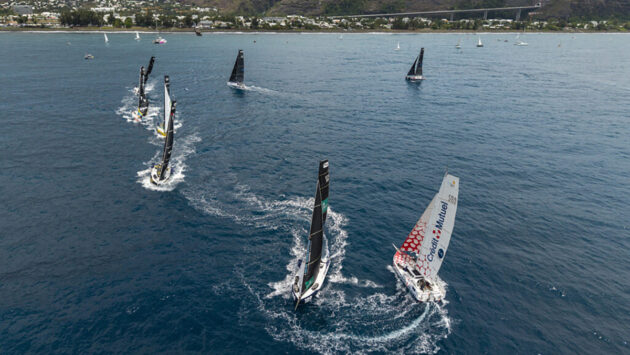
Jostling for position at the start of Leg 3 from Reunion. Photo Jean-Marie Liot/Globe40
In the 21 years since the Class40 box rule was formed the boats have become progressively faster, with a big step change in performance coming with the advent of the first scow bow designs just months after our steed, Jangada 40, was launched in 2017.
Today’s scows are even faster, with legendary double Vendée Globe winner Michel Desjoyeaux noting the new Class40 he sails is as quick as the 60ft IMOCA in which he won the 2000-2001 Vendée Globe.
The Globe40 fleet is therefore split in two very distinct groups, with the scow bow designs way out in front, even though they are designed to the same box rule as the older so-called sharp or pointy bow boats.
Nevertheless, within each of the two groups there’s remarkably close racing. The first three boats to reach Reunion at the end of Leg 2 – Belgium Ocean Racing – Curium, Next Generation Boating, and Crédit Mutuel crossed the line just 9 minutes, 22 seconds minutes apart. Similarly, at the finish of Leg 3 in Sydney harbour after 27 days at sea we were less than 10 miles behind Melodie Schaeffer’s Whiskey Jack.
Globe40 contenders
There’s a huge amount of talent and experience in the fleet, although Schaffer is the only competitor who’s racing around the world a second time. She completed the inaugural Globe 40 on Whiskey Jack, winning one leg and setting the 24-hour race record – a performance that earned several honours, including Canadian Rolex Sailor of the Year.
Belgium Ocean Racing – Curcium, headed by Jonas Gerckens, currently leads the overall standings two points ahead of Ian Lapinski’s Crédit Mutuel.
Gerckens’ team has pushed impressively hard. In Leg 2 Benoit Hantzperg, with sponsor Renaud Dehareng as co-skipper, set a new 24 hour distance record for Class40s at 457.41 miles, representing an average speed of 19.07 knots. In the following leg, with both Gerckens and Hantzperg on board, they hit 31.5 knots maximum boat speed – a figure that might have been considered extraordinary for a 40ft short-handed yacht only five years ago.
Pre-race favourite was unquestionably Crédit Mutuel, the newest boat in the fleet, launched in late 2024. Lapinski has a stellar track record and is one of only two people to have notched up consecutive Mini Transat victories in the race’s 48-year history.
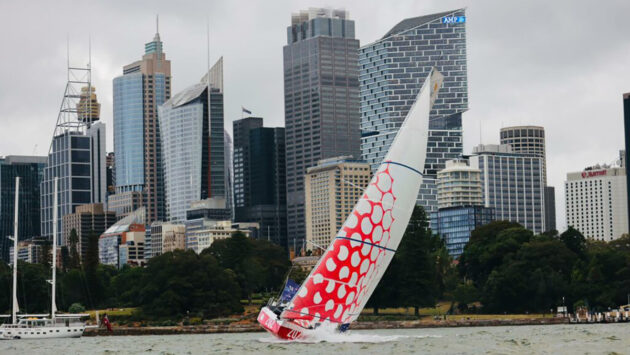
Credit Mutuel at the finish in Sydney. Photo: Jean-Marie Liot/Globe40
His pool of co-skippers includes triple Transat Jacques Vabre winner Antoine Carpentier and Amélie Grassi, whose recent successes include victory in The Ocean Race Europe on Biotherm. Lapinski will take a rest for the next leg, when Carpentier will be joined by Grassi’s husband, British Figaro, IMOCA and Ultim sailor Alan Roberts.
Barco Brasil skipper José Guilherme Caldas is an amateur sailor with an enviable track record, including a trio of victories in the 3,300-mile Cape2Rio race. Barco Brasil is his second Class40.
Caldas approaches sailing with the same passion for learning and diligence that led to him becoming one of his country’s top neurosurgeons, chosen to operate on Brazilian President Luiz Inacio Lula da Silva when he needed emergency brain surgery a year ago.
Sailing with co-skipper Luiz Bolina, Caldas currently holds 3rd place overall and leads the older sharp bow designs.
Reunion based Thibaut Lefevere’s Free Dom is 2nd in the sharp bow category, having led this division of the fleet into Sydney by a considerable margin.
Austrian Lisa Berger shot to fame in 2019 when she won the inaugural EUROSAF Mixed Offshore European Championship, finishing the 187 mile race a comfortable 36 minutes ahead of Gerckens, who took second place. Bergen subsequently spent three years racing Mini 650s, culminating in the 2023 Mini Transat.
Damage limitation
The young German team of 27-year-old Lennart Burke and 24-year-old Melwin Fink, on Next Generation Boating, showed excellent promise from the outset and even beat Lapinski and Grassi at the end of Leg 2, albeit by only 116 seconds.
However, near disaster befell the Germans a week after the start of Leg 3, when a D2 shroud and associated spreader fitting broke. Impressively, they were able to keep the mast upright and make a temporary repair, but were forced to head north into calmer waters, returning to Reunion under a mainsail with four reefs.
They are now awaiting an ultrasound scan of the carbon mast to determine whether repairs to the spar itself are necessary and will rejoin us in Recife for the final leg back to Lorient.
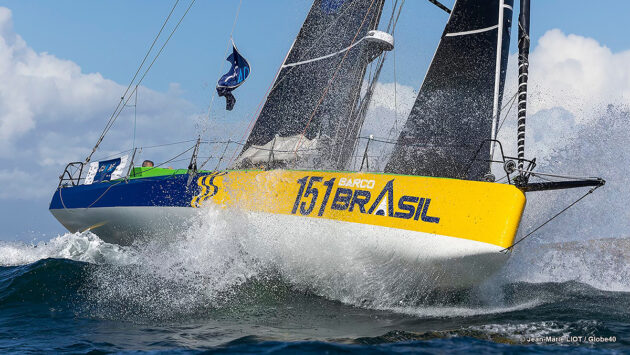
Start of the Prologue Race of the Globe40 from Lorient in September 2025, Photo: Jean-Marie Liot/Globe40
Next Generation is of course not the only team that has encountered breakages and problems with equipment, while several spinnakers also succumbed to their fate.
Jangada 40 had a comprehensive refit ahead of the race and we have been fairly fortunate so far, with only two issues that cost tangible time. The first was a failure of the splice that attaches the sock for the A6 kite to the halyard – an incident that cost valuable points on the first leg. Once the sail fell in the water it was quickly chewed up by the hydrogenerator blades and had to be replaced.
The second issue concerned an elongation of the bobstay during leg 3. We had been sailing at speeds up to 20 knots with the FRO set in 30 knot plus winds and 5 metre seas, but luckily spotted the problem before there was damage to the sprit. However, it was six days before the sea state subsided enough to shimmy out to the end of the sprit to make a repair, during which time we again lost valuable miles.
Globe 40 race: Leg 4
The Globe40 race restarted today, January 1, 2026 on Leg 4, covering 7,000 miles to Valparaiso, Chile started in Sydney Harbour.
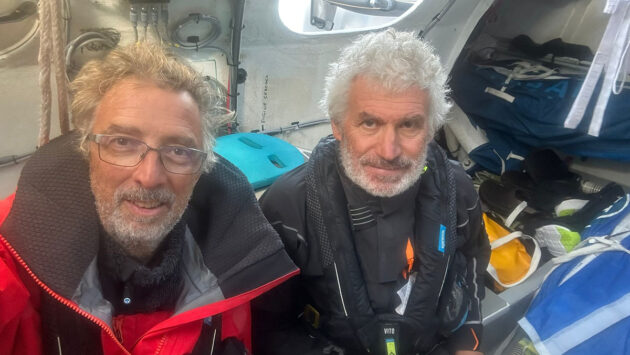
Rupert Holmes (right) and Richard Palmer are competing in the 2025/26 Globe 40 two-handed round the world race on Jangada 40
Leg 5 then takes the flat around Cape Horn and north to Recife, ahead of the final 4,600 mile stage back to Lorient, where they are scheduled to arrive mid April.
Rupert Holmes is competing in the 2025/26 Globe 40 two-handed round the world race with Richard Palmer on Jangada 40.
Follow the race at globe40.com/en and facebook.com/globe40
The post What it’s like racing double-handed around the world in a 40-footer appeared first on Yachting World.