From an unloved 90s yacht to a 136m cargo ship, Matt Sheahan explores how the AeroRig’s rebirth is finally making wind-powered trade a reality
There was little doubt that the Ian Howlett-designed 70-footer Fly, built by the Elephant Boatyard on the River Hamble, was an innovative and impressive bluewater cruiser when launched in 1991. And while she sailed brilliantly and was ridiculously easy to handle, there was something myself and photographer Malcom White couldn’t bring ourselves to say in front of our hosts.
Elegant as the hull lines were, when you looked at the overall package she wasn’t pretty. In fact, Fly’s AeroRig was so unusual that it was difficult to imagine that this configuration would ever be accepted by the mainstream – and sadly it wasn’t.
On the other hand, the rotating mainsail and foresail combination had some significant benefits, the best being her reaching performance and the ease with which this huge rig could be handled.
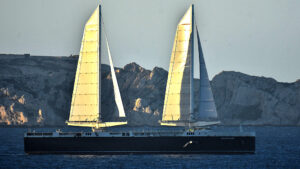
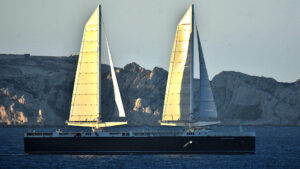
Now, over 30 years later, a very similar rig configuration has appeared on a large commercial ship. The Neoliner Origin claims to be the world’s first-ever commercial sailing roll-on/roll-off (ro-ro) vessel. At 136m in length and displacing 11,000 tonnes fully loaded, Neoliner Origin is only slightly smaller than, say, the Brittany Ferries cross-channel ferry Barfleur.
Owned by the French shipping company Neoline, the ship made its maiden voyage in October 2025 from St Nazaire on the west coast of France, across the Atlantic to St Pierre et Miquelon, the small French island enclave off the coast of Newfoundland, and then on to Baltimore, Maryland, on the east coast of the USA.
Its first cargo included Renault hybrid cars, forklift trucks, an industrial quantity of brioche, and an impressive half million bottles of Hennessy cognac.
Article continues below…

Bezos vs. Musk: Is Amazon’s Kuiper the real Starlink killer? – Matt Sheahan
Space is back in fashion, and with media interest at a level not seen since the days of the Apollo…

Is the Olympic Sailing medal becoming just a participation trophy? – Matt Sheahan
What should an Olympic medal represent? Is it still sport’s ultimate accolade? Is it a demonstration that you’re the best…
Harnessing the power of the wind to propel modern merchant vessels has been attempted with varying levels of success for decades. But where this ship is different is that it was designed from the outset to be a full-size ro-ro merchant ship powered by sail. It even has a pair of retractable daggerboards. This sets it apart from many of the sail-assisted vessels that are scattered around the world where wing sails, kites and rotating cylinders have been retrofitted, sometimes rather jarringly.
While the ship was built in Türkiye by RMK Marine, the project is very French. The twin swing-rig is designed and produced by SolidSail, a subsidiary of Chantiers de l’Atlantique, the huge state-owned shipyard at St Nazaire. The ship has an air draught of 88m, but the masts can be folded for manoeuvring in port and under bridges.
With 3,000m² sail area Neoliner Origin’s unstayed rigs rotate so they’re head to wind for hoisting and lowering and then trimmed accordingly.
With the stated aim of reducing greenhouse gas emissions by 80-90% compared to conventionally powered vessels on the same transatlantic route, SolidSail suggests that 1,000 tonnes of fuel can be saved per rig in the course of a year.
And if you fancy experiencing it for yourself, up to 12 passengers can be accommodated, with a transatlantic passage coming in at a little under £3,000.
There are plans in the works for even more ambitious projects. Already in build at St Nazaire is a 220m sailing yacht which will have three of the 1,500m² swing rigs fitted. And SolidSail have published designs for a larger truck-carrying ro-ro, and even a 300,000 tonne crude oil tanker. The world’s third-largest container ship operator CMA CGM, based in Marseille, is a major stakeholder in the project, so there’s substantial financial backing.
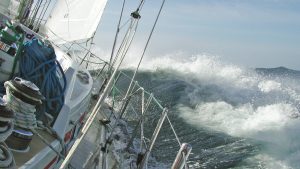
The decision to test the concept in the North Atlantic was a brave one, and there was a glitch on the first voyage when bad weather caused damage to one of the mainsails leaving just one of the rigs operating. The vessel’s diesel-electric powerplant took up the slack, but repairs were effected that allowed the return trip to be carried out under full sail. A second transatlantic return trip was accomplished over the Christmas period, but at the time of writing the ship was tied up in Lorient where it’s reported that modifications were being made to its sails.
With looks being less of an issue in the hard-nosed commercial world, the hope is that a 35-year-old concept has at last found its true calling and can deliver a genuine contribution to the future of cleaner commerical shipping.
 If you enjoyed this….
Yachting World is the world’s leading magazine for bluewater cruisers and offshore sailors. Every month we have inspirational adventures and practical features to help you realise your sailing dreams.Build your knowledge with a subscription delivered to your door. See our latest offers and save at least 30% off the cover price.
Note: We may earn a commission when you buy through links on our site, at no extra cost to you. This doesn’t affect our editorial independence.
The post The commercial ship which uses 80% less fuel and proves the AeroRig’s worth appeared first on Yachting World.