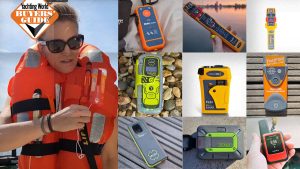
If you head offshore or participate in competitive sailing then you’ll need to consider a PLB and/or an AIS beacon. Tech Editor and marine safety gear and comms specialist, Fox Morgan has tested an array of the current beacons on the market to help you decide what’s the best one for you.

Locating a crew member who has fallen overboard in anything other than the most benign of conditions is a huge and frankly scary challenge for those on board. If you are not sure whether you should have a PLB or an AIS beacon, this guide will help you work out which device is right for your type of boating. The answer might just be both.
Your odds, as a person overboard, of being recovered are less than 50:50 according to the latest MAIB report stats. Add a lifejacket and your odds of being found are still marginally 50:50, but you at least might survive long enough to be rescued—provided your lifejacket has a sprayhood, light, and reflectors. If you have been thrown a danbuoy or Jonbuoy MOB marker, you have a slightly higher chance of being seen. But when you are alone in mountainous seas, there are a couple of pieces of tech that will up your odds of being found to over 90%.
Important for 2026: As of 15 April, it is now a legal requirement to register all 406 MHz PLBs carried on UK-flagged vessels and powered watercraft.
Jump to PLB
Jump to satellite trackers
At a glance:
The best personal AIS beacons available right now
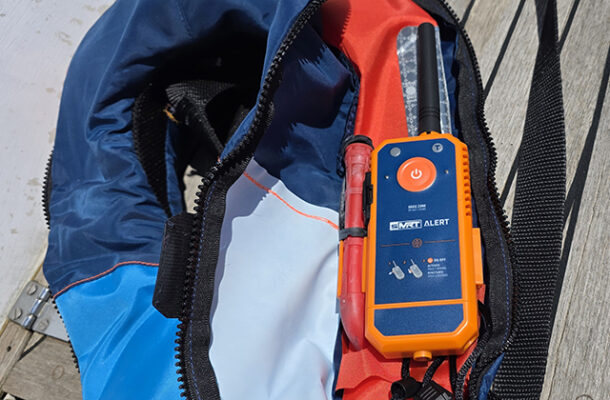
sMRT alert AIS beacon
Specifications: Alerting Radius: Up to 5NM (depending on antenna height) | Battery Life: Minimum 12 hours at -20°C (5-year shelf life) | Waterproofing: IP67 | Dimensions: 137mm (H) x 62mm (W) x 26mm (D) | Weight: 212g | Features: M-class compliant, DSC automatic calling, NFC enabled
Reasons to buy: A flat, slim, robust unit that is simple to use | Internal DSC receiver confirms when a distress signal is acknowledged | Powerful signal with smartphone app management
Reasons to avoid: Not a satellite beacon | Works only with localised rescue operations
The first M-class compliant AIS beacon to come to market in 2024, this is the beacon I wear daily. It is a chunky item, and whilst I have this mounted inside my lifejacket, I have also used it attached to my lifejacket belt or in a pocket. It doesn’t need the lifejacket to inflate to activate; simply immerse it for 2 seconds in water or press the big button. It really is an “idiot-proof” device.

Ocean Signal MOB 2
Specifications: Positioning: GNSS via GPS and Galileo | Battery Life: 5 years (12+ hours operational) | Waterproofing: Waterproof to 10 metres | Weight: 92g | Features: M-class compliant, AIS/DSC, Integrated NFC, IR/White strobe lights
Reasons to buy: A small device that fits into almost every lifejacket on the market | Designed for automatic activation when a lifejacket bladder inflates
Reasons to avoid: Can be a fiddly device to set up initially | May require a service agent
The most popular AIS man overboard device (the MOB 1) has received a refresh and is now M-class compliant. As part of a new initiative to avoid clutter on emergency VHF DSC channels, these beacons follow the new M-class protocol. It looks very much like the old model, but features a tapered lower body making it even slimmer, and NFC connectivity for easy battery status checks.

McMurdo S20 Lifejacket AIS Beacon
Specifications: VHF Range: 4nm typical (with receiver antenna >5m above sea level) | Battery Life: 36 hours operational (5-year shelf life) | Waterproofing: IP68 | Dimensions: 129mm x 52mm x 40mm | Weight: 160g
Reasons to buy: Flat, slim unit fits easily in most lifejackets | Simple manual activation designed to work within a lifejacket casing
Reasons to avoid: Requires professional fitting for automatic activation | Not a satellite device; limited use if sailing solo far from other vessels
I have had this unit fitted to most of my lifejackets in the past. It is simple to operate: a swift pull of the lanyard slides the housing off and the beacon begins transmitting. The casing can take quite a sharp pull to remove, so it is worth practising to familiarise yourself with the force required. Under the red removable case is a second slide-out piece with a magnet; this must be all the way out for the unit to function.

Ocean Signal RescueMe MOB1 AIS
Specifications: Operating Frequency: 161.975/162.025 MHz | Battery Life: 7-year shelf life; 24+ hours operational life | Waterproofing: 10-metre depth | Dimensions: 134mm x 38mm x 27mm | Weight: 92g | Features: Integrated DSC transmitter, high-intensity strobe light
Reasons to buy: Exceptionally slim design fits almost every lifejacket on the market | The smallest and lightest AIS unit currently available
Reasons to avoid: Not a satellite beacon; limited effectiveness for solo sailors in remote waters | Can be fiddly to set up for automatic activation
Introduced in 2015, this compact personal AIS beacon remains incredibly popular due to its diminutive size. It is designed to fit neatly next to the oral inflation tube of a lifejacket. While it can be set to activate automatically upon inflation, the setup is somewhat fiddly and must be redone every time the lifejacket is serviced. The integrated strobe light is a brilliant addition for final precision locating of a casualty at night.

ACR AISLink MOB Personal Beacon
Specifications: Operating Frequency: AIS Channel 1 (161.975 MHz), AIS Channel 2 (162.025 MHz), DSC (156.525 MHz) | Battery Life: 7-year shelf life; 24+ hours operational life | Waterproofing: 10 metres | Dimensions: 115mm x 46mm x 27mm | Weight: 92g | Features: Manual or automatic activation, high-intensity LED strobe light
Reasons to buy: ACR is a tried and trusted name in the marine safety gear market | Simple activation; can be configured for automatic deployment | Comes with a variety of fixing methods for different lifejackets
Reasons to avoid: Not a satellite beacon | Will not notify rescue services via satellite if sailing solo far from other vessels
ACR is to emergency maritime equipment what Hoover was to vacuum cleaners; in the USA, people often simply refer to these units as “ACRs”. This model is an AIS-only unit. When activating the device, the central grey panel is pulled away, revealing a sprung antenna that unfurls rapidly to stand at 90 degrees. Beware of your eyes when inspecting how this part works! It is a reliable, no-nonsense piece of kit from a market leader.

Weatherdock Easy 2-MOB
Specifications: Operating Frequency: AIS 161.975/162.025 MHz; DSC 156.525 MHz | Battery Life: 12+ hours operational life | Waterproofing: IP68 (fully buoyant) | Dimensions: 195mm x 50mm x 30mm | Weight: 120g | Features: Bluetooth connectivity, DSC “closed loop” distress call for up to 8 ships, red LED torch
Reasons to buy: Built-in buoyancy; the unit floats if dropped | Uses Bluetooth to program a “closed loop” of vessels for immediate notification | Fully automatic activation on contact with water
Reasons to avoid: Risk of accidental trigger if sailing in extreme conditions due to the water-contact sensor | Uses a salt capsule for auto-activation which requires periodic replacement
The Easy 2-MOB immediately begins sending emergency signals to a group of up to eight vessels (including the mother ship) in a closed loop upon water contact. These MMSI numbers are easily programmed via Bluetooth using a free smartphone app. To fit the unit, you simply slide it upside down between the folds of the lifejacket bladder. I particularly like the “armed/disarmed” slider, which gives you peace of mind when packing the gear away.

SIMY My-MOB
Specifications: Positioning: 72-channel GPS and AIS SART transmitter | Battery Life: 7-year built-in battery; 24+ hours continuous operation | Waterproofing: Fully waterproof | Dimensions: 115mm x 40mm x 22mm | Weight: 95g | Features: Coiled spring antenna, manual or automatic activation options
Reasons to buy: Very small and compact; fits easily into a lifejacket | Manual operation is incredibly simple | Developed by specialists in miniaturised space electronics
Reasons to avoid: The manufacturer is less well-known in the general marine safety market | Like all AIS units, it is not a satellite positioning beacon
Digital Yacht teamed up with SIMY (a division of the space company Syrlinks) to create this beacon. When activated, the red cover slides downwards to reveal a coiled antenna that looks a bit like a slinky spring. Once it acquires a GPS signal, it transmits your location to any vessel with an AIS receiver. While the manufacturer states a range of up to 10nm, in reality, you should expect closer to 4nm when floating at water level. Its unique cover design only requires a 1cm movement to auto-activate, making it very reliable when triggered by a lifejacket inflation strap
Best Personal Locator Beacons (Satellite radio beacons)
The best combined AIS and PLB

Ocean Signal PLB3
Specifications: Signals: 406MHz satellite beacon & AIS radio beacon | Battery Life: 24 hours at -20°C | Weight: 190g | Dimensions: 20cm x 3.6cm x 3cm | Features: Return Link Service (RLS), NFC connectivity
Reasons to buy: Combined AIS and satellite location in one unit | Only one battery to maintain and replace | Can be semi-automatically activated by lifejacket inflation
Reasons to avoid: At the top end of the price range | Quite long and may be a struggle to fit in smaller lifejackets
This is the first beacon to combine both PLB and AIS units in one. It is essentially the MOB 1 and the PLB 1 stacked together, creating a stick-style beacon. After hands-on testing, we can confirm it fits the majority of offshore lifejackets, but be aware it stiffens one side of the jacket considerably. The auto-arming procedure is quite fiddly, so I recommend having it fitted by a professional service centre.

ACR ResQLink View
Specifications: Signals: 406MHz satellite with Return Link Service (RLS) | Battery Life: 28 hours operational | Weight: 148g | Dimensions: 11.48cm x 5.16cm x 3.78cm | Features: Digital LCD screen, built-in strobe light
Reasons to buy: Smooth, easy-to-operate unit with a helpful LCD screen for user feedback | RLS confirms that your distress signal has been received
Reasons to avoid: Fiddly to stow in a pouch due to the wraparound aerial design
This PLB unusually incorporates a small LCD screen, which fundamentally improves the user experience by providing status updates. The Return Link Service pings back a confirmation that your signal has been reached. It uses a hinged base for the aerial which reveals the activation button once rotated. The clear housing makes it very easy to inspect for water ingress.

ACR ResQLink 400
Specifications: Signals: 406MHz satellite, 121.5MHz homing signal | Battery Life: 5-year shelf life; 24+ hours operational life | Waterproofing: 5 metres for 1 hour; 10 metres for 10 minutes | Dimensions: 114.8mm (L) x 51.6mm (W) x 37.8mm (D) | Weight: 144g | Features: Built-in buoyancy (it floats!), GPS & Galileo GNSS, strobe and infrared strobe
Reasons to buy: Inherently buoyant without needing an extra pouch | Simple, robust design with global MEOSAR compatibility | Includes a multi-function clip system for various attachment options.
Reasons to avoid: The wraparound aerial can make it a bit of a faff to extract from tight neoprene pockets |Does not feature a digital display (see the ResQLink View for that)
ACR is to emergency maritime equipment what Hoover was to vacuum cleaners. The ResQLink 400 is a reliable, “no-frills” version of their premium beacons. I like the simple manual activation: you slide the aerial tab out and rotate the hinge, which automatically reveals the protected activation button. Because the casing is clear, you can easily inspect the “gubbins” inside for any accidental water ingress or damage during your periodic safety checks. It’s a solid, trustworthy choice that literally keeps its head above water.

McMurdo Fastfind ReturnLink Personal Locator Beacon with RLS
Specifications: Signals: 406MHz satellite with RLS | Battery Life: >24 hours at -20°C | Weight: 164g | Dimensions: 36mm x 50mm x 112mm | Features: Rubberised outer casing, multiple attachment kits
Reasons to buy: Reassuringly ruggedised and easy to grip with cold hands | Fits easily into a pocket or lifejacket
Reasons to avoid: No built-in floatation; must be tethered | No AIS functionality for local vessel notification
The FastFind feels like a quality bit of kit. Activating it is simple: pull up a small lever and pull hard to break the tab, allowing the top cap to be removed. The aerial then unwinds to stand at 90 degrees. It is one of the best PLBs on the market, but remember it does not have AIS, so you may want to pair it with an AIS beacon if you want nearby boats to find you quickly.

Ocean Signal RescueMe personal locator beacon
Specifications: Signals: 406MHz satellite, 121.5MHz homing signal | Battery Life: 7-year shelf life; 24+ hours operational life | Waterproofing: 15-metre depth | Dimensions: 77mm (H) x 51mm (W) x 32.5mm (D) | Weight: 116g | Features: 66-channel GPS, retractable antenna, high-intensity strobe (>1 candela)
Reasons to buy: Exceptionally small—roughly 30% smaller by volume than most competitors | Long 7-year battery life reduces maintenance frequency | Designed for easy single-handed operation
Reasons to avoid: Does not float on its own; requires the provided flotation pouch to stay buoyant | The tiny size might be difficult to operate for those with very large hands or when wearing thick gloves
This is the ultimate “fit and forget” beacon. It’s so small that it fits comfortably onto a lifejacket belt or even in a trouser pocket without being cumbersome. Unlike many other units, the antenna is manually pulled out and rewound using a little finger winder on top. This means you won’t accidentally “have your eye out” when deploying it, though you must remember to pull it out before hitting the trigger in an emergency. It’s a proven lifesaver that has been featured in numerous real-world rescue stories.

McMurdo FastFind 220 PLB
Specifications: Signals: 406MHz satellite, 121.5MHz homing signal | Battery Life: 6-year shelf life; 24+ hours operational life | Waterproofing: 10-metre depth | Dimensions: 106mm (L) x 47mm (W) x 34mm (D) | Weight: 152g | Features: Galileo & GPS GNSS, SOS Morse code LED flash, safe-stow antenna
Reasons to buy: Robust, ruggedised design that feels substantial in the hand | Very simple three-stage activation process | Excellent value for money for a global rescue beacon
Reasons to avoid: No inherent buoyancy (though it comes with a flotation pouch) | Lacks the Return Link Service (RLS) found on the newer FastFind models
The FastFind 220 is a classic in the sailing world. It is a rugged, waterproof, and GPS-enabled beacon that builds on the success of the older 210 model. It doesn’t float on its own, so you must ensure it’s either in its pouch or securely tethered to your gear. The secondary 121.5MHz homing transmitter is a vital feature, as it allows Search and Rescue teams to home in on your exact location once they arrive in the general area. It’s a dependable, “workhorse” piece of safety kit.

Kannad SafeLink SOLO
Specifications: Signals: 406MHz satellite, 121.5MHz homing signal | Battery Life: 5-year replaceable battery; 24+ hours operational life | Waterproofing: 10-metre depth | Dimensions: 112mm (H) x 36mm (W) x 50mm (D) | Weight: 150g | Features: 50-channel integral GPS, SOS LED flashing light, multi-attachment kit included
Reasons to buy: Great value for money for a globally recognised beacon | Comes with a comprehensive kit: lanyard, buoyancy pouch, and universal carry pouch | Simple three-stage activation (snap off the cap and press the button).
Reasons to avoid: Not buoyant without the flotation pouch | The 5-year battery life is shorter than the 6 or 7 years offered by some rivals
The SafeLink SOLO is a reliable, budget-friendly entry into the PLB market. It operates on the global COSPAS-SARSAT system, just like the more expensive units. Activation is straightforward: you snap off the top cap to reveal the button. It also features a manually activated SOS LED light, which is a massive help for visual identification in the dark. While it doesn’t have the “premium” feel of some high-end units, it does exactly what it says on the tin: it gets you found.
The Best Satellite trackers / personal beacons

Garmin InReach Mini 2
Specifications: Weight: 100g | Waterproofing: IPX7 | Dimensions: 5.17cm x 9.9cm x 2.61cm | Features: 2-way messaging, SOS button, TracBack routing
Reasons to buy: Tiny device that fits into any compact gear set-up | Excellent battery life (up to 90 days in certain modes)
Reasons to avoid: Some may find the tiny interface fiddly to use | Requires a monthly subscription
The Garmin InReach Mini 2 is a wearable device you’ll virtually forget is there. You can send and receive texts via Bluetooth on your smartphone or use pre-set messages directly from the unit if your phone dies. It’s a brilliant tool for keeping family informed of your progress during a passage without needing a full satellite phone.

Zoleo Sattelite Communicator
Specifications: Dimensions: 91mm x 66mm x 27mm | Weight: 150g | Waterproofing: IP68 (Dust and water-resistant to 1.5m for 30 mins) | Battery Life: 200+ hours (checking messages every 12 mins) | Features: Dedicated UK SMS number and email, 24/7 SOS monitoring via Global Rescue, seamless network switching (Satellite/Cellular/Wi-Fi)
Reasons to buy: Assigned a permanent dedicated number, making it easy for contacts to initiate a message to you | Rugged, shock-resistant design (MIL-STD 810G) with a handy built-in clip | Least-cost routing automatically uses Wi-Fi or mobile data when available to save satellite credits
Reasons to avoid: Relies heavily on a smartphone and the ZOLEO app for sending/reading custom messages | No built-in screen; status is indicated via four LED lights
The ZOLEO is a smart little messenger that bridges the gap between your mobile phone and the Iridium satellite network. I particularly like the “Check-in” button on the device itself; you can let your shore contact know you’re safe with a single press, which sends your GPS coordinates without needing to faff with your phone.

ACR Bivy Stick
Specifications: Dimensions: 113.5mm x 47mm x 21.1mm | Weight: 100g | Waterproofing: IPX7 | Battery Life: Up to 120 hours (standard operation) | Features: 24/7 SOS monitoring by Global Rescue, GroupTrack (track up to 12 users), 1/4-20 thread for mounting
Reasons to buy: Extremely lightweight and pocket-friendly | “Rollover” credits mean unused satellite messages carry over to the next month | Compatible with thousands of GoPro and camera mounts thanks to the threaded base
Reasons to avoid: Not as ruggedly protected as the ZOLEO; no rubberised outer casing | No on-device screen or interface beyond status LEDs
The Bivy Stick effectively transforms your smartphone into a global satellite communication hub. It’s one of the lightest trackers on the market, and the app interface is one of the cleanest I’ve used, providing pace, altitude, and detailed offline maps. A standout feature is the “GroupTrack”, which allows you to see other Bivy users in your party on a shared map—brilliant for coordinated flotillas or multi-boat expeditions.
How to choose the right personal locator beacon for you and your boating activity
You have two choices: an AIS type beacon which when activated shows up as a circle with a cross on any AIS radar screen of nearby vessels (upto 5 mile range) and allows any vessel that can see this signal to home in on it locally. Some handheld AIS radio devices can also help target a MOB signal too. – Icom M94DE VHF Marine Radio
You could use a personal AIS beacon from a liferaft to assist in local SAR efforts where small craft are trying to locate you as part of a coordinated effort. This is how Kirsten Neufshafer found Tapio in his liferaft when his boat sank rapidly in the Golden Globe race 2022. Accidentally triggering an AIS beacon can be cancelled by simply switching off the unit and an all stations call by VHF to nearby vessels who may have seen the MOB signal appear.
There’s also the PLB which communicates with overhead satellites in the same was as a ships EPIRB (electronic position indicating radio beacon) and works on a frequency picked up by satellites alerting search and rescue teams ashore. ( via a network of control centres). This type of device does NOT give a localised AIS signal that a small vessel could pick up. The battery life is a little less than a ships EPIRB but essentially it does the same thing, just in a very small device. You might use a PLB of this type to signal a mayday situation, such as from a grab bag or life raft and you might not necessarily be a person overboard to use this, but it should only be used in case of grave and imminent danger to life. Accidental triggering of one of these requires a call to the coastguard to cancel the distress signal officially.
The post Best personal locator beacons and AIS units 2026: 16 top options for boating appeared first on Yachting World.