Andy Rice explains the latest technology that could make yacht racing smarter, easier, and less reliant on volunteers
We’re all time poor. The word ‘pastime’ is barely still in modern usage, because we simply don’t need ways of passing the time – instead we’re seeking to carve out small chunks of leisure in our ever-busier schedules. And that has made it harder and harder for us to justify time-intensive activities like a long weekend of yacht or dinghy racing.
Michael Morin is a lifelong sailor who is committed to helping find solutions to this challenge. While the digital revolution has been a large cause of the problem, Morin believes new technology can help alleviate it too.
“I belong to Bayview Yacht Club in Detroit. We have probably just as many boats in the harbour as we have ever had,” he says. “Actually, we have more boats in our harbour because we expanded our harbour more than 10 years ago. But when I began sailboat racing 40-some years ago, we had twice as many boats on the racecourse as we have today.”
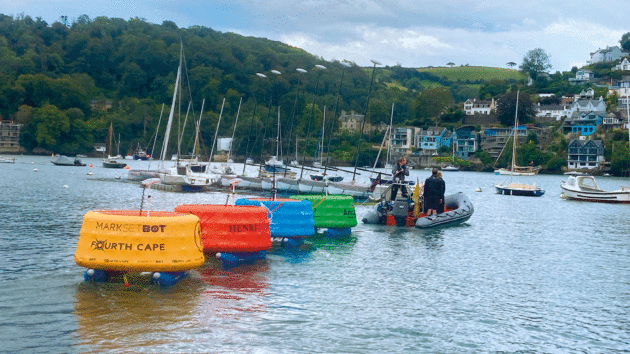
MarkSetBots being towed out to course. They have electric motors to hold station or change position. Photo: Paul Todd/outsideimages.com/NYYC
He believes one reason is that sailing is just too time consuming. “You get out and you’re waiting for your race to start; then it starts and you get a general recall… If you’re involved in a regatta it just takes up so much time. People are time-poor and it is a real problem for families. So, while there are more boats in the Bayview harbour, there are fewer people who are racing every Wednesday, every Tuesday, every Saturday.
“Because there are fewer people racing, there are fewer volunteers. We have ageing volunteers and fewer people offering to volunteer. That’s a real big struggle for clubs.”
Today Morin is the director of sales and marketing for MarkSetBot, a company founded by his son, Kevin, in 2014 producing robotic, motor-powered racing marks. Kevin is a member at Pontiac Yacht Club in Michigan, where every sailor is required to do race committee duties twice a year.
Setting a course in areas of the lake that are particularly deep, Kevin reckoned if he could come up with a way of replacing the mark-laying boat, each sailor would only need to volunteer once a year. MarkSetBot was born and has been developed through more than 600 iterations to the point where these remote-controlled marks are now used in SailGP, the America’s Cup, Olympic classes and many more.
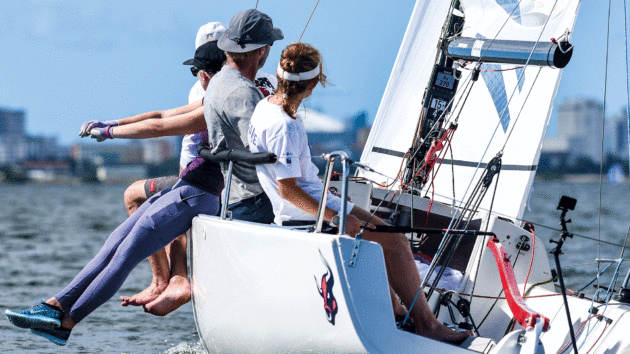
The J/70 class has adopted the Vakaros system after being plagued by general recalls at many championship events. Photo: Douglas Wake/Vakaros
MarkSetBots are inflatable buoys with their own propulsion, battery powered engine and integral GPS. They have no anchor, removing the need for mark layers. They can carry sensors for wind data, and even be fitted with horns to automate the start sequence or signal course changes.
They can also be moved mid-race if the wind shifts, can hold position against most states of wind and tide, and can be controlled remotely from either a committee vessel or onshore.
Simon Nearn, president of the Australian 18 Footers League in Sydney, is a big fan of the MarkSetBots.
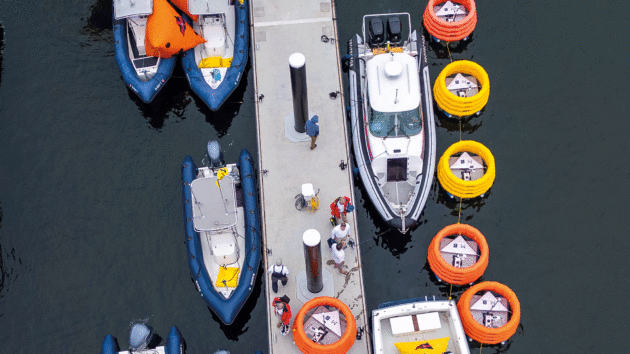
The electronic marks can be used for a whole course or to supplement traditionally laid/fixed marks. Photo: Paul Todd/outsideimages.com/NYYC
“We’re into our second season and we love them,” he says. “Our race officers love them because they can sit in the bar on their mobile phone and say, ‘I want to put the marks here, here, and here,’ and the marks will go there.
“There is a cost element. Because we rent them at the moment, we’re thinking about whether we should own them. But then we’ve got to store them, and that’s a logistical hassle.
“But from a race management perspective, they’ve been a bloody beauty, especially with handicap races. You can adjust them: ‘Oh, the wind’s got a bit lighter, let’s make the marks a bit closer and keep the race running.’”
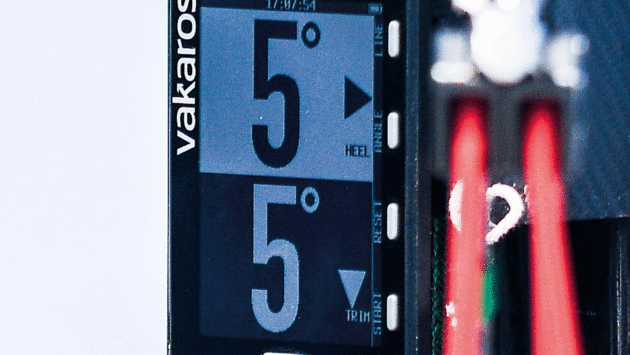
Vakaros Atlas 2. Photo: Douglas Wake/Vakaros
Mobile marks for yacht racing
Race time and efficiency is even more vital on the SailGP global circuit. With a strict 90-minute broadcast window for SailGP events, the movable marks are an essential part of the setup, enabling principal race officer Iain Murray (a former 18ft Skiff champion) and his team to shrink, expand or rotate the course axis depending on the shifting strength or direction of the breeze.
It’s not a flawless system. At the Sydney SailGP event in early March Australian skipper Tom Slingsby complained: “You’ve got a minute to go and you’ve got your spot on the start and you see the [robot] start mark just take off.” That’s not usually the fault of the technology so much as a race official moving the mark a bit too late into the sequence, but it’s something to be aware of.
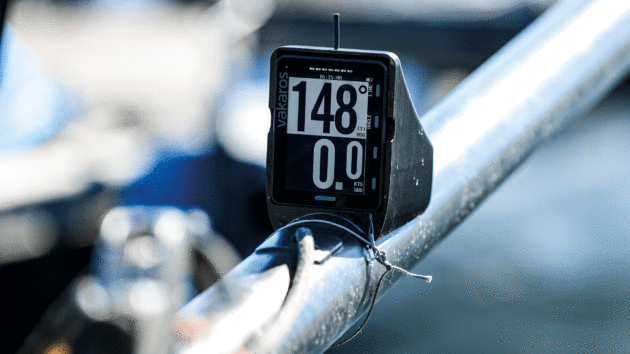
Smaller Edge units. Photo: Douglas Wake/Vakaros
There are other learning curves with the robotic marks, as Nearn points out.
“There have been some funny incidents where somebody drags the mark. Imagine the guy in front of you hits it and drags it. Now you’ve got to go around it, but that mark starts motoring back to where it’s supposed to be. You’re now coming in on your starboard layline into a moving mark because it’s trying to motor upwind to its designated GPS location. There are some funny foibles to using these marks, but overall the experience is really positive.”
Hands-free package
In recent years MarkSetBot has been collaborating closely with instrument manufacturer Vakaros. Launched in 2016 by sailors Jake Keilman and Todd Wilson, Vakaros is one of the more prominent players in a market saturated with GPS-enabled products designed to help sailors track their personal data and performance on the water.
The Vakaros system combines a race management app with dedicated hardware units. It provides both competitors and the race committee with an automated start countdown and instant OCS alerts, as well as performance data and live tracking via the onboard compass/timer units.
It removes the need for race committees to manually identify and record boats that are over early at the start, as it automatically records who is over the line and who has dipped back, and also records finish time/positions.
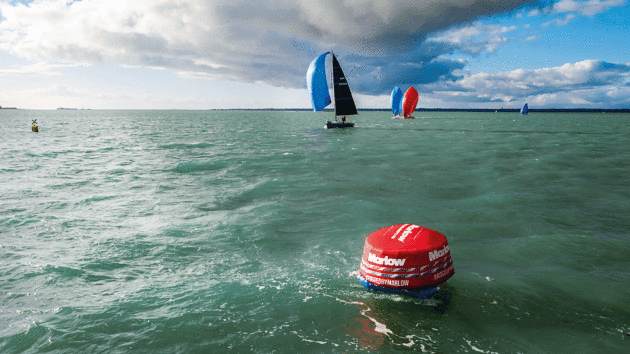
MarkSetBots reduce the need for mark-laying volunteers and can be controlled by smartphone app.
Transformational technology
While at first glance a Vakaros Atlas 2 unit might look expensive at just under £1,000, co-founder Wilson says some classes see the cost more than offset by the improvement in their sailing experience (there is a smaller Edge model, which can also be rented as a package for events).
“A good example is the J/70 class where people put a value on their time and enjoyment in the sport, and on avoiding the common frustrations of the sport,” says Wilson. “A Vakaros unit is a small investment compared to almost everything else they are doing.”
Vakaros’s race management system is called RaceSense. Among many useful functions normally run by a race committee, it provides a simple green light/red light indicator to tell a sailor if he has started behind or in front of the line. Wilson claims the experience has been transformational for the J/70 fleet.
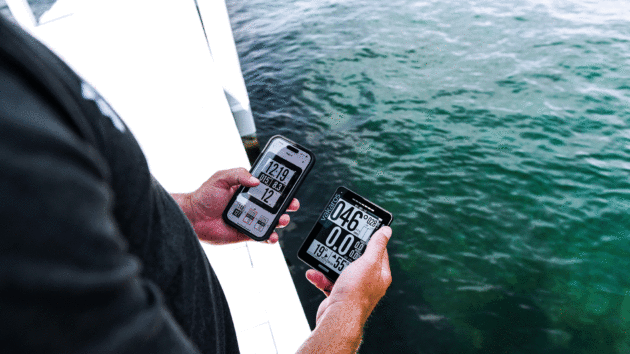
Besides the race management advantages, sailors can use smart devices to capture valuable performance data. Photo: Vakaraos
“The last two J/70 Worlds have used RaceSense, and the J/70 Class uses RaceSense officially for all of their major international events and most national events.”
Some clubs are switching in this direction too. The J/70 is an excellent example of a class where they’ve experienced the pain of many general recalls leading to Black Flags, and sometimes having days of not being able to get off racing at all due to those challenges.
“There is no Black Flag because you can return to start. In the 2024 Worlds in Palma, [competitor and frequent J/70 pro] Mark Foster told me it was possibly the first time ever that a J/70 Worlds had run the entire regatta with only the ‘P’ flag. You can throw away all those other flags; you can put them in a museum.”
The 18ft Skiff fleet also experimented with using Vakaros for its racing, although has now moved away from using it for the time being. “We started using Vakaros a couple of seasons ago but we found we didn’t have enough reliability,” says Nearn. “I’d say we were an early adopter and we couldn’t find reliability in our hostile environment.
“The 18s are punishing on equipment. We were putting the units at the bottom of the mast, below the vang collar. It gets pretty wet in there; you’ve got people dropping kites and the Cunningham going through that position. I don’t think it was robust enough at that time, but it’s something we’d consider again in the future.”
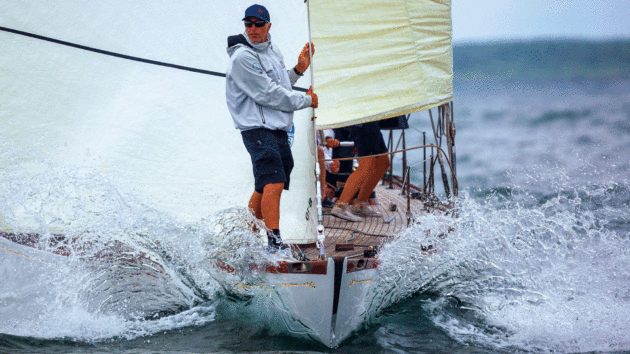
‘They can be moved mid-race if the wind shifts’. Photo: Paul Todd/outsideimages.com/NYYC
Critical calls for yacht racing
Another major player is Velocitek. Velocitek pioneered combined GPS/speed/compass units which could measure distance to line with the ProStart, which was adopted by top sailors and events, including many International Moth sailors who often used it to record eye-watering top speeds.
Last year Velocitek launched a new RTK puck which allows race committees to automate many functions such as ‘pingless’ distance-to-start, synchronised countdown times, and immediate OCS (On Course Side) calls. The ‘RTK’ technology behind it is based on Real-Time Kinematic GPS, which was first developed for use in sailing for the 34th America’s Cup by legendary navigator Stan Honey and offers positioning accuracy of less than 2cm.
Part of the reason why classes like the 18ft Skiffs and International Moths have been able to be early adopters of such technology is they’re independent of the governance of World Sailing and the red tape that can go with that. The Olympic classes, on the other hand, have to seek permission through the multiple checks and balances of the committees at World Sailing to make even small changes to equipment or race management.
However, progress is on its way. Ben Remocker is class manager for three Olympic classes – the Nacra 17 catamaran and the 49er and 49erFX men’s and women’s skiffs – and among the keenest to push forward with implementing new ideas. Remocker believes technology could transform the experience for his Olympic sailors as well as race officials.
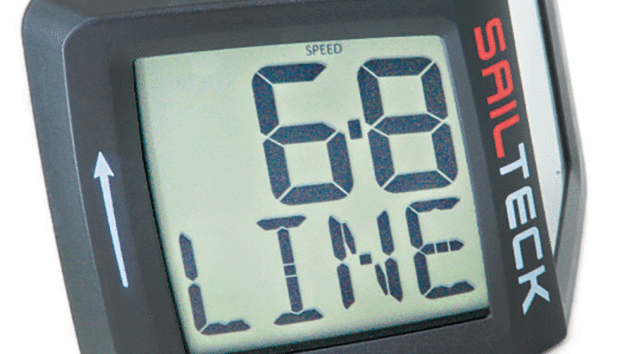
SailTeck’s GPS Compass is solar powered with 300 hours of data storage for export and race replay
“I don’t think there’s anything more frustrating to a sailor than winning a race – only to find out you were called OCS,” says Remocker. “That moment you go through the line thinking, ‘Did they not blow a whistle or a horn on purpose, or because they’re not paying attention?’ and then you’ve got your whole emotional investment tied up in your race… it’s such an odd situation to be going through in sport.”
In what can be career-deciding races, where titles or selection are at stake, an ‘eyeball’ OCS call will often be challenged by sailors.
“They want to listen to the recording of the start – so the race officers now all have to record themselves talking into a microphone as evidence. Then they want to see the video, the pin-end video, and hear the pin-end microphone. Then they still want to protest because they think they can prove they were behind the line. It goes on for literally hours. That can all be avoided,” explains Remocker.
No whitewash
Aside from the massive time-waste of OCS disqualifications and the whole rigmarole of general recalls and subsequent restarts, Remocker sees other opportunities for new technology to make the day more efficient.
“As sailors we all want to tune up and sail and be ready for starts, but we also have to loiter around the race committee boat waiting for them to get into a sequence so we can get the time synchronised. You have to make sure you’ve got a line of sight; you can’t be too far away. You’ve got to get your watch ready and be looking, and then everyone tries to play ‘broken telephone’ between a bunch of flags and horns.
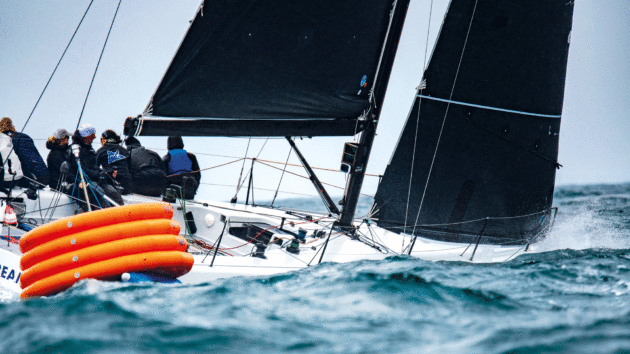
Once the race is underway, the Velocitek units show electronic compass, speed and heel readings. Photo: Paul Todd/outsideimages.com
“With a system like Vakaros, that all gets automatically synchronised. Not only do you not have to worry about pressing your [watch] button, but you can just forget about it. It will pop up with ‘11 minutes to go’ to your start. You’re doing your tuning runs and you don’t have to stop and go back.”
A side benefit may be that if no one is trying to ‘hide’ on the start line, the whole sport could become more colourful and more commercially appealing to sponsors.
Remocker comments: “This technology gets rid of the desire for everyone to be invisible and for everyone to have white boats. Suddenly, you could have massively branded boats because no one has the fear of being seen over the line anymore. People can put logos, colours, and personality all over themselves and their equipment.”
Article continues below…
What it’s like racing double-handed around the world in a 40-footer
We are deep in the South Atlantic on a screaming reach, riding the leading edge of the semi-permanent cold front…
New Wallyrocket 71: The Next Generation Racing Yacht
Wally launches a second Rocket. If the name and look seem familiar, it’s because we ran plenty of coverage of…
Radio range
While brands like Vakaros are expanding rapidly, others are nipping at their heels. Mark Johnson has been producing digital compasses for racing sailors going back to the start of the century when he and his brother, Clive, launched the popular TackTick race compass.
In 2024 Mark launched the SailTeck brand, which he believes could make race management and tracking hardware more affordable than ever. With a retail price of £599 for the newly launched SailTeck GPS Compass – which comes with GPS, bluetooth, inbuilt solar panels, and a two-mile radio transmitter and receiver – Johnson believes sailors will find buying a unit for themselves accessible.
Only recently launched to the market, Johnson says it will take most of this year to test and validate SailTeck Live, which will use the two-mile radio range for some interesting possibilities.
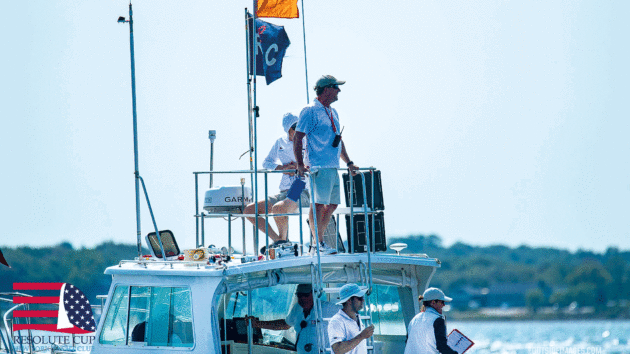
Time-to-line function can replace ‘pinging’ to remove congestion, or classes can choose to keep it eyes-on-distance. Photo: Paul Todd/NYYC
“It means if you have a line with a SailTeck unit on it – you could put it on a committee boat – the committee presses the button and everyone gets the start time. Everyone knows where the line is. If anyone is over, they get an ‘over’ message and they know to go back.
“The entire race is tracked. Every SailTeck has the position of all the other SailTecks in it.
“You could set the line up virtually; you don’t have to have a committee. You could put the line on the buoys and someone could press the button and start the race that way. It can run handicaps and automatic correction as you go around. And at the end of the day’s racing you go home with everyone else’s data on all the other units, so you can analyse the racing in great detail.”
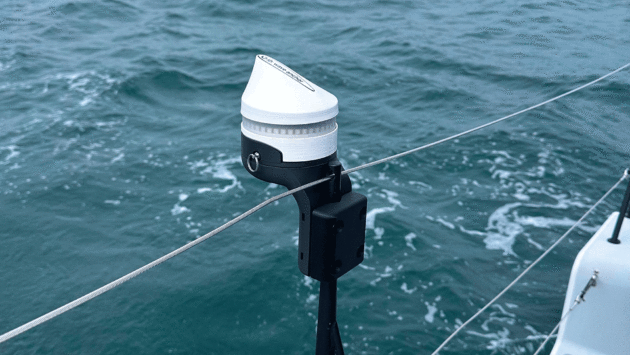
Velocitek stern-mounted RTK GPS ‘puck’ is calibrated to the size of boat to give distance and time to start, position etc.
Accelerated learning
For competitive sailors the idea of data sharing is also an exciting prospect, says Remocker. In SailGP, all the data from the F50s is centrally held and shared in an online cloud, enabling the back markers to see what the winners are doing differently with their setup and manoeuvres.
Remocker sees similar opportunities with the upcoming application of Vakaros systems in the 49er and Nacra 17 fleets.
“We as a class haven’t officially decided what we’re going to do with all the information, but I suspect the teams want to prepare themselves for pro careers and want to get used to handling and analysing data. I expect we’ll have quite an open environment.”
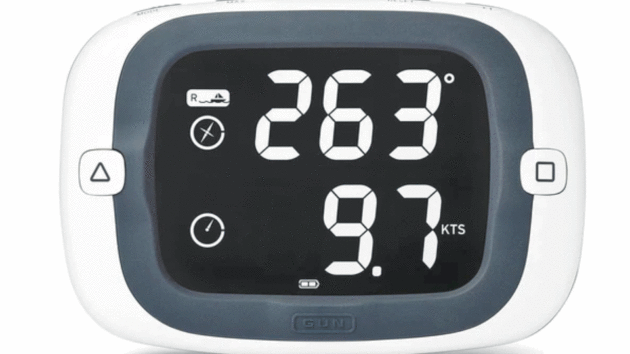
Velocitek ProStart can show time and distance to line, OCS, plus performance data like speed and heading.
Aside from the Olympic level, Remocker hopes that traditional sailing clubs and classes will also be more open to adopting new technology at the grass roots.
“A race officer could go out with a fleet and as many robotic marks as they need, with one person on a tablet controlling the Vakaros system and all the robotic marks. It diminishes the need for protests, and two people could probably go out and control a day better than what would currently take close to 10.
“It could dramatically reduce the cost of running regattas at all levels.”
 If you enjoyed this….
Yachting World is the world’s leading magazine for bluewater cruisers and offshore sailors. Every month we have inspirational adventures and practical features to help you realise your sailing dreams.Build your knowledge with a subscription delivered to your door. See our latest offers and save at least 30% off the cover price.
Note: We may earn a commission when you buy through links on our site, at no extra cost to you. This doesn’t affect our editorial independence.
The post Can smart systems save club racing? – The latest technology that could make yacht racing faster appeared first on Yachting World.