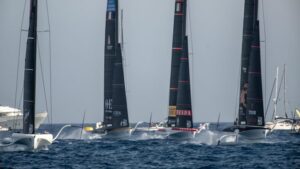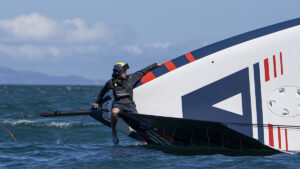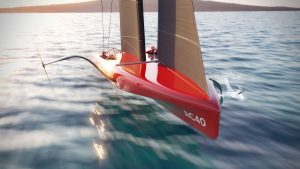
All about the AC40, which will be used for the Youth and Women’s America’s Cups and the America’s Cup preliminary series
The 38th America’s Cup will be retaining the AC75 foiling monohull class for the actual Cup match in Naples, but the technical framework has seen a seismic shift. While the cutting-edge AC75s remain the flagship, the smaller AC40 one-design foiling monohull returns to play an even more integrated role in training and talent development.
Under the Protocol for the 38th America’s Cup, the AC40 is central to the extensive preliminary schedule. Teams are permitted to field up to two AC40s in the initial preliminary regattas.
These events mandate a mixed crew profile, utilising the AC40 to seamlessly blend core squads with emerging talent. Crucially, the Youth America’s Cup and Women’s America’s Cup will both continue to be contested exclusively in the AC40 class.
While the Women’s and Youth events remain a standalone feature of the ecosystem, the 38th America’s Cup has also introduced a mandatory requirement for at least one female athlete to be on board the larger AC75 during the main Cup racing.
With limited AC75 sailing team a key feature of cost control, teams entering the 38th America’s Cup rely heavily on the AC40 platform alongside advanced simulators — originally pioneered by the Defender, Emirates Team New Zealand — for pre-delivery simulation, data analysis, and crew coordination.
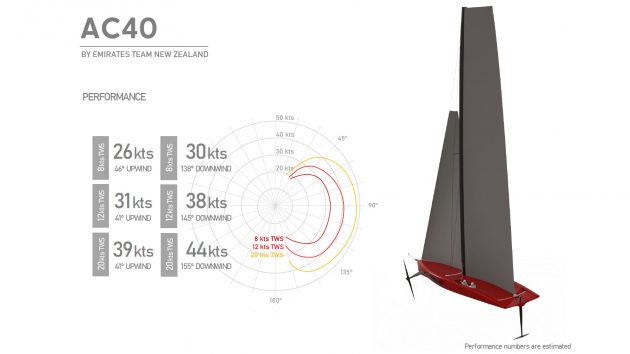
The Birth of the AC40
In the run-up to the 36th America’s Cup in Auckland, teams built custom, modified 30-to-40-foot test platforms (often referred to as LEQ12s) to get to grips with the untried concept of large, keel-less foiling monohulls. These platforms allowed designers to experiment with foil shapes and soft wingsails before committing to their AC75s.
The last team to launch a test platform during that era was the Defender, Emirates Team New Zealand. Their boat, Te Kahu, was launched late but benefited immensely from the Kiwis’ highly advanced simulation and computing platforms.
When Emirates Team New Zealand co-wrote the subsequent rules, they modelled the one-design AC40 hull shape directly from their heavily developed, Cup-winning AC75, Te Rehutai. For the 38th America’s Cup, custom LEQ12 development platforms have been strictly banned to contain costs, cementing the AC40 as the definitive training and data-gathering tool for every syndicate.
Alsongside these LEQ12 bans, the ability to modify AC40s for training remains, allowing them to be technology test beds – though they must return to one-design rules for competition.
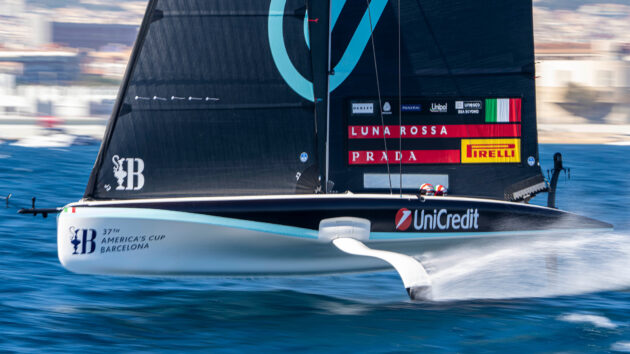
How does the AC40 work?
The AC40 is engineered to behave much like its larger sibling, the AC75. It features two large, canting, weighted foil arms on either side of the boat and completely lacks a traditional keel. The yacht foils on a single hydrofoil at a time, keeping the windward foil raised out of the water to eliminate drag and maximise righting moment.
With only four crew members on board, the AC40 relies heavily on automated systems. It features an entirely battery-powered system that handles the foil cant, wing flaps, rudder trim, and sail actuators (as will the AC75 this time around) completely eliminating the need for physical grinders. Automated flight-control systems maintain ride height, while self-tacking headsails ease the workload during high-speed manoeuvres.
The rig mimics the AC75’s signature setup: a D-shaped mast where two separate sail skins are hoisted simultaneously to create a highly efficient soft wingsail. This system offers aerodynamic control comparable to a hard wing but allows the sail plan to be easily raised and lowered. The AC40 does away with a traditional boom, utilising internal hydraulics to dynamically twist and shape the sail from foot to head.
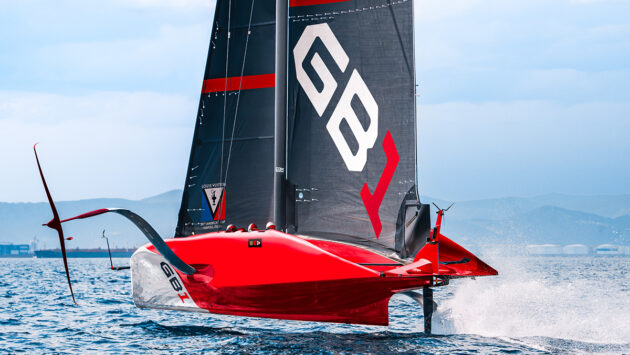
Is the AC40 a one-design?
The AC40 serves a dual purpose. For the Youth and Women’s America’s Cups, as well as the early preliminary regattas, the boats are strictly stripped back to conform to the one-design AC40 class rule, ensuring a completely level playing field where pure sailing skill and tactical execution decide the winner.
However, teams also use the platform as a foundational testbed. Because the 38th America’s Cup rules enforce strict cost-containment measures, restricting teams to a single, recycled or modified legacy hull from the 37th or 36th editions and banning wind tunnel testing, the AC40 provides a cost-effective environment to trial foil wing profiles, flap configurations, and electronic control software before implementing them on the primary AC75 match boats.
 If you enjoyed this….
Yachting World is the world’s leading magazine for bluewater cruisers and offshore sailors. Every month we have inspirational adventures and practical features to help you realise your sailing dreams.Build your knowledge with a subscription delivered to your door. See our latest offers and save at least 30% off the cover price.
Note: We may earn a commission when you buy through links on our site, at no extra cost to you. This doesn’t affect our editorial independence.
The post AC40: The America’s Cup class’ younger sister appeared first on Yachting World.