The iconic paradise of St Vincent and the Grenadines delivered perfect sailing days and an authentic Caribbean experience for Saskia Stainer-Hutchins
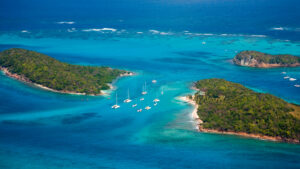
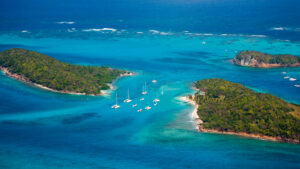
How many places in the world can truly claim to be an iconic sailing destination? St Vincent and The Grenadines (SVG), a scattered chain of 32 idyllic Caribbean islands, certainly earns that title.
Line-of-sight sailing, consistent tradewinds, diverse island experiences, crystal clear waters and established nautical services make this a favourite cruising ground for all types of sailors. Given their popularity, we perhaps underestimated the difficulty of sailing these waters (more on that later). Nevertheless, we found the mix of comfortably challenging cruising and tropical islands to explore to be the perfect balance.
We’ve been sailing the world for the past four years on our Lagoon 46 and visited SVG as part of our north-bound journey through the Caribbean. In one season we hope to make it from Trinidad to the USA, a distance of some 1,500 miles and more than 20 countries. You could spend almost a whole season exploring SVG, so the two or so weeks we’d allocated seemed painfully short. But it was, perhaps, representative of the typical visit, because most sailors visiting these shores do so on a timeline.
Charter favourite
SVG is a favourite of charter boats and sailing rallies (including the World ARC and Cruisers’ Rally) as well as hundreds of independent sailors like us. Hotspots like the Tobago Cays can attract more than 3,000 boats per season.
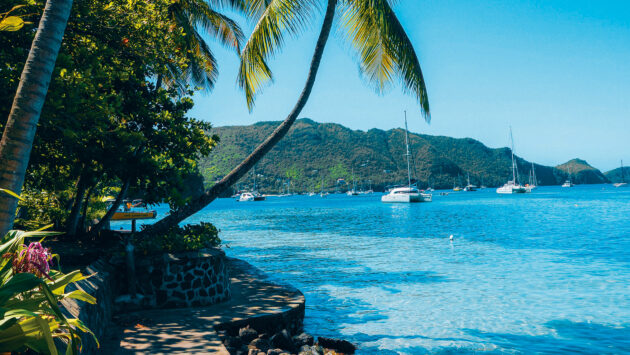
Beautiful Bequia was a highlight of the couple’s Grenadines tour. Photos: Saskia Stainer-Hutchins/Ross Rodrigues
We visited when the hurricane season had only just finished, in early November, and found many anchorages to be already fairly crowded. Luckily the coastline offers plenty of alternative spots and we learned quickly that identifying back-ups for back-ups was a necessary planning step for every location.
From Grenada in the south we headed to Chatham Bay in Union Island. We started here because you can check in at this remote anchorage. The process involves an official taking your documents and riding over a mountain to customs! Union suffered a direct hit from Hurricane Beryl in 2024 and was still visibly rebuilding. We were keen to support the recovering businesses built around the isolated bay, which included a memorable beach barbecue with local chefs Vanessa and Seckie.
Article continues below…
This bay was typical of SVG in that the anchorage was roughly split between an area devoted to mooring balls and an anchoring area. Mooring balls are everywhere in the Caribbean but we’ll always choose to anchor if we can, as we trust our Rocna more than any ball. This suspicion was underlined dramatically in Chatham when a boat broke its ball mooring during our stay (the owners were aboard so disaster was averted). Otherwise we spent three peaceful days working on the boat, punctuated with snorkelling sessions in gin clear water.
In the Windward Islands we found we could often get away with a rhumbline approach to our next anchorage, but in doing so were sailing around the edge of our boat’s capability at 40-45° apparent. True wind speeds are usually in the 20s around this time of year so those two factors combined can make for a bumpy sail upwind.
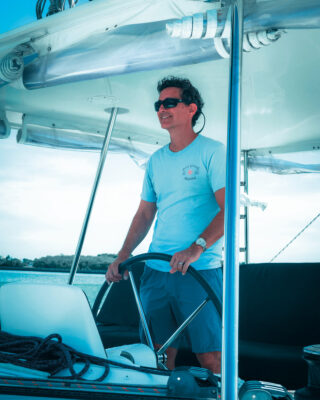
Ross at the helm of their Lagoon 46 Acushnet. Photos: Saskia Stainer-Hutchins/Ross Rodrigues
In addition, there is often a west-setting current between all the Lower Antilles that is typically anywhere from 1-2 knots, forcing you to crab more into the wind to maintain course. This rule of thumb was true throughout our journey north. Therefore, our next hop up to the famous Tobago Cays was short but intense. The weather was a little spicy so we reefed heavily.
A jewel in the crown
The Tobago Cays, a five-island archipelago, are the jewel in the crown of the Grenadines. They are pristine, and reminded us strongly of our days sailing in French Polynesia. We’d been told by other sailors that the horseshoe reef that protects these islands had been damaged by Hurricane Beryl, making anchorage conditions slightly uncomfortable at high tide. Despite a steady 15-20 knots of wind during our stay, we experienced some definite chop but thankfully nothing that would chase us out of the anchorage.
We spent the majority of our time at the Cays in the water and saw dozens of turtles, sting rays and eagle rays as well as numerous moray eels, lobsters and tropical fish.
We did learn to be on our guard, though, after one of the famous ‘boat boys’ (local entrepreneurs who provide fish, fruit, bread, and mooring ball assistance to visiting yachts), ran over my brother while he was snorkelling. Luckily, he missed the propeller and escaped with only a bump on the head, but it was an important lesson in remaining alert at all times.
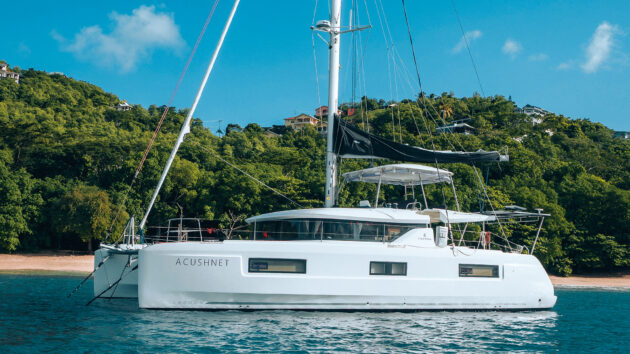
Finding an uncrowded but protected anchorage required research and multiple Plan Bs. Photos: Saskia Stainer-Hutchins/Ross Rodrigues
Bequia welcome
Our next stop was supposed to be Mustique, the island so famously favoured by the likes of Mick Jagger and Princess Margaret. However, we bailed halfway through and headed to Bequia instead. Early in the season the winds are predominantly north-easterly in the Windward Islands, meaning that northbound sailing is almost always hard on the wind. Getting directly from the Cays to Mustique was going to require many long, painful, tacks upwind. The seas, rolling in straight from the Atlantic, were high and the true wind more than 20 knots.
Mustique, we decided, could wait. Instead we tucked behind Canouan, motored through its wind shadow, tacked through the island’s wind refraction on either end and then ploughed through the open sea at 50° to reach the safety of Bequia by late afternoon. We raised the sails four times that day and changed the trim more times than I can count, though we were at sea for less than five hours. It was worth it for a joyful little sporty sail as we caught the wind outside Canouan, and all in sight of land.
Our favourite stop by far was the island of Bequia, a magnet for cruisers. The picturesque town of Port Elizabeth hugs lush hills that tumble down into a turquoise bay. The island has great restaurants, fantastic hikes and easy-to-use dinghy docks. The boat boys here have diversified their services and offer everything from the usual wares to full laundry service, diesel fuel and drinking water and fresh croissants.
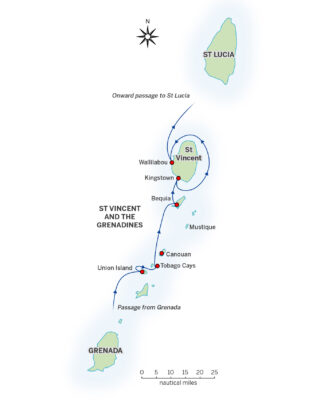
The Route
Culturally the island felt quite unique as Bequia was originally a distinct community built on a whaling industry that is kept alive today. Bequia is one of only a handful of places in the world still allowed to hunt whales using traditional methods (they target humpbacks and have a quota of four per year, which they very rarely meet). At a small museum we met volunteers who passionately explained their community’s long held tradition. They even serenaded us with songs habitually called out whenever a whale is spotted offshore.
Besides the tourist attractions, we found the people of Bequia particularly welcoming. We arrived at an unusual time, with the island gearing up for political elections. But we were determined to find some authentic nightlife so, after visiting a picturesque floating sailor bar called Bar One, we followed the sounds of bass ringing across the bay to discover a local karaoke bar. Tourists were obviously rare visitors there, but we were instantly made to feel at home. Several happy hours of singing later we left with many friends and countless new memories.
Bequia’s popularity was evident from the start. The ample Port Elizabeth anchorage was stuffed with yachts, even this early in the season. This did cause a few minor headaches. When we originally anchored, way at the back of the crowd, we decided to dive the anchor to make sure it was secure, only to discover the bottom was just a thin layer of sand over rock and our holding was, in fact, not the most secure.
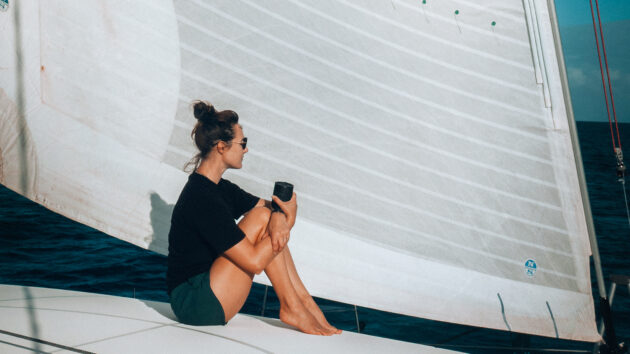
Saskia relaxing. Photos: Saskia Stainer-Hutchins/Ross Rodrigues
Next, we decided to carefully pick our way further into the crowd and anchored in a perfect patch of sand, tucked in between the eel grass, right by the beach. This idyllic positioning was highly coveted, however, and over our four days in Port Elizabeth several boats chose to anchor painfully close to us. One evening was so tight we even put out fenders.
Some sailors in the Caribbean pride themselves on sailing ‘off the hook’, even in the tightest anchorages. I’ve already witnessed one crash when someone attempted this in Florida, and find myself on edge whenever someone decides to do this. Sure enough, a boat anchored not far from us chose to sail off the hook, but got caught by an unexpected wind eddy and very narrowly missed a small monohull. No damage was done, but many angry words were exchanged – crowded anchorages are not for the faint of heart!
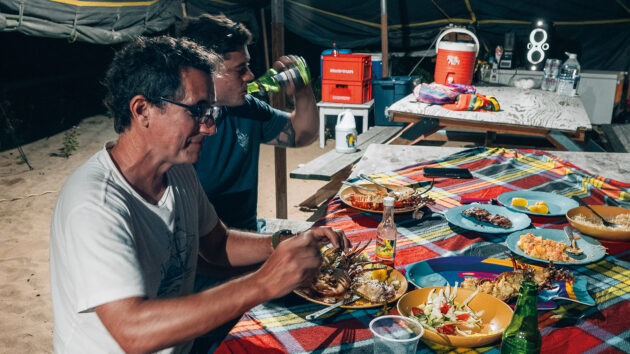
Photos: Saskia Stainer-Hutchins/Ross Rodrigues
Best laid plans
Our extremely short sail from Bequia to the main island of St Vincent was perhaps unnecessarily adventurous. We motored until well away from the anchorage before raising our sails, and picked a spot on the tip of the bay, where we anticipated the tradewinds would have established themselves. We duly started motoring into the wind to raise the main, but instead encountered a powerful wind refraction that had the autopilot turning us back towards the land… and at speed as the waves also demanded a lot of power to hold course.
Normally this would not have been an issue, but – inevitably – this was the moment that a reef line got caught and the whole process took slightly longer than we wanted. We lived to tell the tale, but our hearts were certainly pumping and we left feeling suitably humbled.
A few short hours later we made it over to the mainland having passed through a sporty series of small squalls that raced across our path. The mixed light these squalls generated in the late afternoon was stunning, creating a spectacular panorama as yachts sailing through were swallowed by the rain.
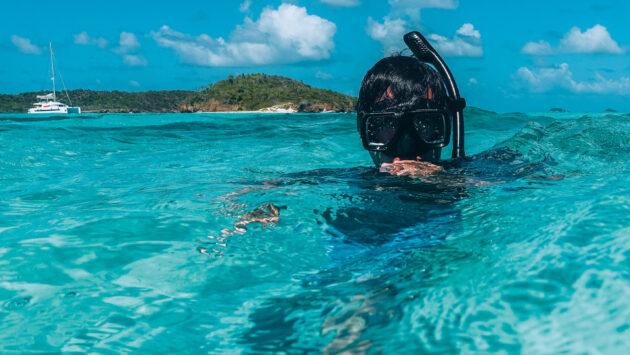
The turtle sanctuary in the famous Tobago Cays makes for unmissable snorkelling. Photos: Saskia Stainer-Hutchins/Ross Rodrigues
Many cruisers choose to avoid the mainland of St Vincent. However, we’re keen scuba divers and had heard it hosted some particularly special sites. The hearsay was not wrong, and the dives we went on were some of the most interesting I have seen so far in the Caribbean. The reefs were notably healthy and colourful, an increasingly rare fact these days. We did not have time to visit the beautiful volcano of La Soufrière, nor the many waterfalls that are scattered across the foothills of St Vincent, so I felt an all-too-familiar sense of remorse as we once again turned north.
We hopped up the east coast of the main island, using a combination of upwind sailing and motoring to navigate the wind shadows. After stopping in a few different anchorages we finally checked out of Wallilabou, famous as a filming location for the Pirates of the Caribbean movies. This bay is extremely deep with only a slim ring of seabed at a suitable depth for anchoring, close to shore.
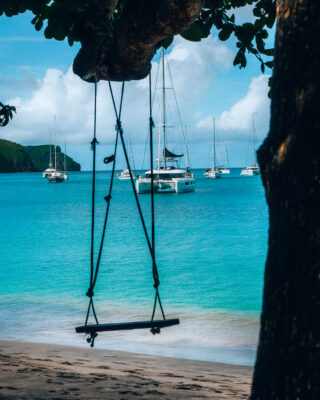
Bequia offered history and a friendly welcome, though its anchorages could get busy even early in the season. Photos: Saskia Stainer-Hutchins/Ross Rodrigues
The local boat boys have capitalised on this and help yachts to stern-tie to shore, a set-up that allows a higher number of boats to visit this small bay,without needing to re-anchor as the wind shifts. The process is quite nerve wracking, as the anchor needs to be dropped precisely before backing down close to the rocks on shore. But we had excellent help from a local boat boy crew in their tender, and were secured just in time to catch the immigration office, which opens for a few short hours at the end of each day.
Wallilabou is one of the most unusual customs experiences: the immigration office is literally housed inside the Pirates of the Caribbean film set. So, while waiting our turn, we explored the mocked-up pirate township and posed with various props, dressing up in pirate outfits for photos!
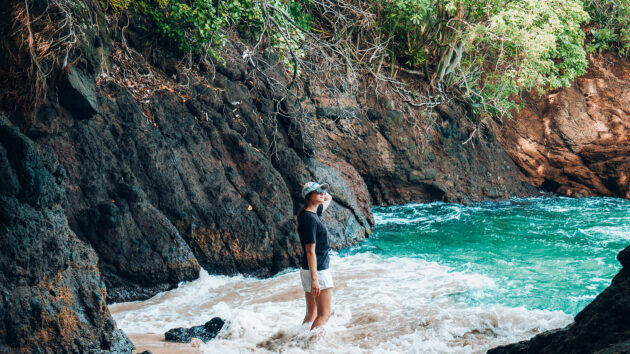
Steady tradewinds make for a consistent swell in many coves and bays. Photos: Saskia Stainer-Hutchins/Ross Rodrigues
Later that night we went for a walk in the pitch black to try and find an open restaurant and stumbled across Sunset’s. An entrepreneurial boat boy called Zico runs this restaurant from his home for passing yacht crews, all the food made by his mother from their home kitchen – and all delicious. We found ourselves in the company of several other cruisers, swapping tales of life at sea. This, of course, is another reason why SVG is such fun: it’s full of sailors.
We met grizzled nomads who have been at sea for decades, bright-eyed families on their first charter experience, and everyone in between.
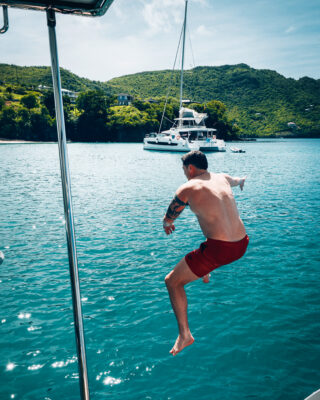
Enjoyable swimming and snorkelling in all the islands. Photos: Saskia Stainer-Hutchins/Ross Rodrigues
On our final morning in St Vincent we rose right before dawn to make a first light exit from the country. Our next destination would be St Lucia, a mere eight hours of sailing away on our cat under normal wind conditions. That passage was another full of memorable contrasts, as we hit a major squall en route and had to drop down to our third reef to comfortably ride out 40-knot gusts. A few short hours later we entered the wind shadow of the Pitons, to discover two magnificent sperm whales at play in the calms.
That evening we lay on the trampoline net and stared at the stars, reflecting on the breadth of experiences SVG had offered us. In two weeks we’d barely scratched the surface on all this stunning country has to offer. I can see why so many sailors return, year after year, always finding something new. Of course, the beautiful white sand beaches, emerald waters and vivid sunsets were picture-perfect highlights. But the real star of the show was the sailing: just enough to keep you on your toes, but not enough to distract you from the tropical wonderland slipping past the hull each day. I cannot wait to return.
 If you enjoyed this….
Yachting World is the world’s leading magazine for bluewater cruisers and offshore sailors. Every month we have inspirational adventures and practical features to help you realise your sailing dreams.Build your knowledge with a subscription delivered to your door. See our latest offers and save at least 30% off the cover price.
Note: We may earn a commission when you buy through links on our site, at no extra cost to you. This doesn’t affect our editorial independence.
The post Finding the perfect balance of paradise and sporty sailing in St Vincent and the Grenadines appeared first on Yachting World.