Janneke Kuysters discovers cruising beyond the Caribbean – from Mexico to the Bahamas and America’s Great Loop
Many cruisers focus on the eastern Caribbean, but there are some amazing cruising options further north and north-east: the Yucatan Peninsula in Mexico, the coastal waters of the US, and the paradise islands of the Bahamas. With the right yacht, you can even opt for America’s Great Loop: an adventure in itself.
So many cruisers dive south to Panama on a tight time frame. But if you’re on a more relaxed schedule, once the warm Caribbean winds have blown you across the Caribbean Sea to Central America, where next?
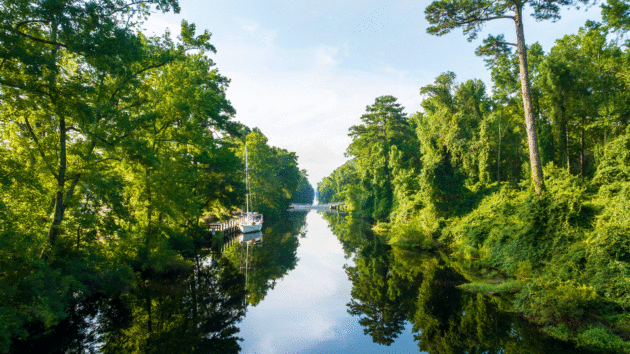
Verdant mooring in the Great Loop. Photo: Chris Major/CM Images LLC
Perhaps you’ve spent the hurricane season in the Rio Dulce in Guatemala and are looking for an adventurous way to go north. Mexico makes for an interesting destination, and is also the starting point of a memorable season which takes you to some lesser-known cruising areas (see map over page). You could do it all in one go, but there are also excellent opportunities to leave the boat for the winter, then come back for more blissful sailing.
Yucatan Peninsula
This loop starts on the Mexican coast, focussing on the Yucatan Peninsula. The tradewinds blow from the north to the south-east, depending on the passage of the fronts. Balmy conditions prevail, but you have to take the sea breezes into account, as the warm land mass makes the wind clock around to the south at the end of the day.
There is a good choice of ports and anchorages to explore; leaving your yacht in port gives you the opportunity to travel inland to one of the spectacular historic Maya sites and learn more about Mexican culture. And the delicious food, of course.
Mexican cruiser Daniel Enriquez sails his Leopard 50 Win Win. He says: “The hurricane season is from June to November, you can still sail along the Mexican coast, but you have to keep a keen eye on the weather forecast. On Isla Mujeres, you can find a safe spot for your boat in the hurricane season.”
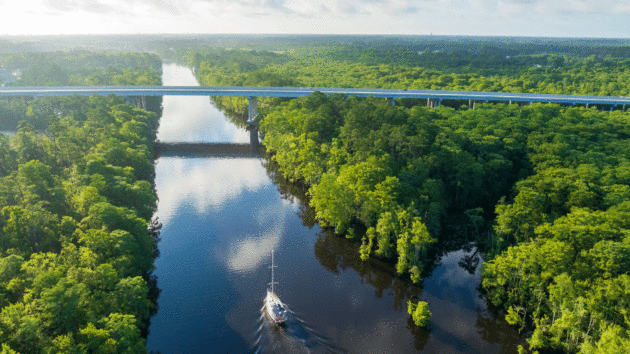
Photo: Chris Major/CM Images LLC
Most of his favourite places are around the north-east of the Yucatan peninsula. “El Cielo anchorage at the southern tip of Cozumel island is a stunning anchorage – crystal clear water, white beaches and lots of wildlife, including manta rays. El Cielo means ‘heaven’ in Spanish and it is indeed a heavenly anchorage,” Enriquez says.
Further north, at the northern tip of Isla Mujeres, is Playa Norte. “This is another one of those magical places, where you can anchor, enjoy nature and relax. A similar anchorage can be found further north-west, at the eastern tip of the Holbox peninsula. Playa Holbox offers sheltered anchoring in azure blue water,” he adds.
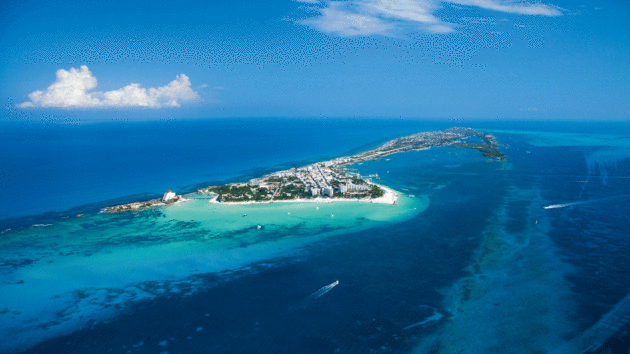
Isla Mujeres off the eastern tip of Mexico’s Yucatan Peninsula. Photo: Salvador Garza/Getty
“But the jewel in the crown is Arrecife Alacranes or Scorpion Reef. It’s a national park and you need a permit to go there. The permits are sold in Progreso on the mainland. After a 70-mile crossing, you get to the most amazing place: it’s uninhabited and wildlife is abundant. Especially in the evening, when the tourist boats are gone, you can enjoy the peace and quiet in this very special place.”
If you want to explore inland, there are marinas in Puerto Aventuras, Puerto Morelos, Cozumel, Cancun and Isla Mujeres where you can leave your yacht.
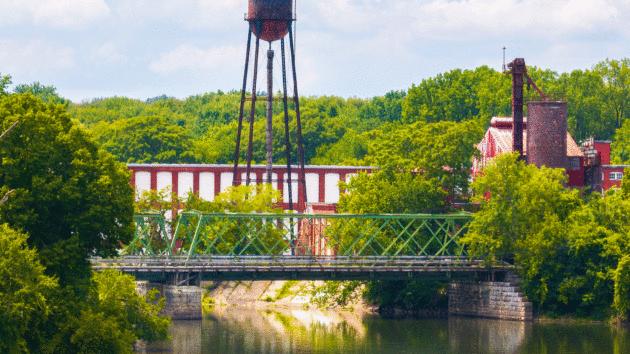
Photo: Chris Major/
CM Images LLC
Panhandle or Keys?
From the Yucatan Peninsula, you have two options: sail north or east. The northern route will bring you to the south coast of the USA, where you can choose to head to Texas, Louisiana, Alabama or Florida.
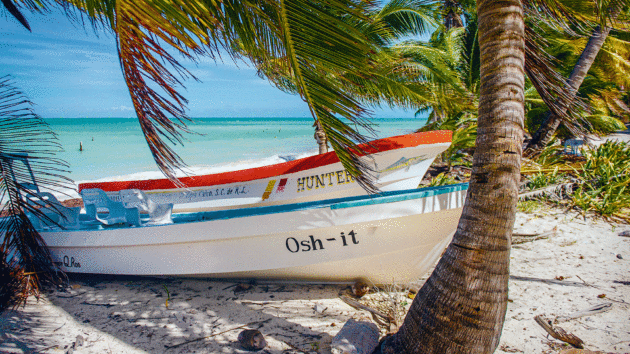
Yucatan beaches fringed with palm trees and painted, tongue-in-cheek-named fishing boats. Photo: Kila Zamana
If you want to make it easier for yourself, you can opt to go through the Intracoastal Waterway of these states. In Mobile, Alabama, there is a yachting community where you could stop for repairs and maintenance.
Along the Florida Panhandle there are some interesting places to visit – Gulf Shores, the anchorage at Pensacola, and party town Destin, also home to extensive nature trails. Following the coast further west then south, you’ll sail to the beautiful Florida Keys, where you can anchor and enjoy the marine life.
The other option is to sail straight to the Florida Keys from Mexico, a 300-mile crossing, which gives you more time to explore Florida and sail across to the next destination – the Bahamas.
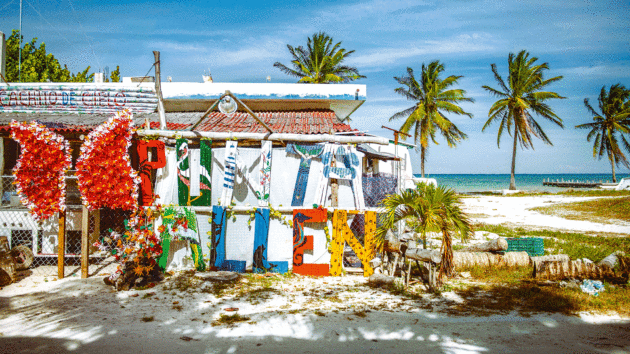
Welcoming community vibes and limited, sustainable development in Punta Allen. Photo: Kila Zamana
Whatever you decide, the ocean currents will help you on your way. First, the Yucatan current flows clockwise in the Gulf of Mexico, and reaches northern Florida, where it meets the Gulf Loop current, an east-flowing current which goes around the southern tip of Florida.
The prevailing winds are north-north-east, so it pays to look for a good weather window for this passage or crossing. Most people prefer June for this reason, but earlier windows do occur.
Article continues below…
Beyond the postcard: Discovering the Caribbean’s hidden corners
Seen one Caribbean island, seen them all? Not at all: the region offers amazing diversity, from incredible habitats to vibrant…

Caribbean sailing: BVIs are back and as beautiful as ever
As the 30-seater inter-Caribbean turboprop aircraft banked to starboard, through my small window I caught a first glimpse of Tortola…
Bahamas
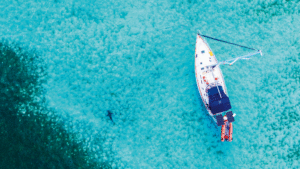
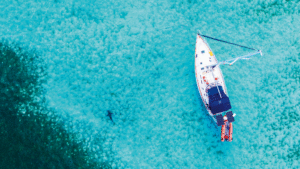
The Bahamas offers an incredible sailing opportunity from the USA east coast, not only the natural beauty but also the proximity – the nearest islands are the Bimini islands, just 55 miles from Miami.
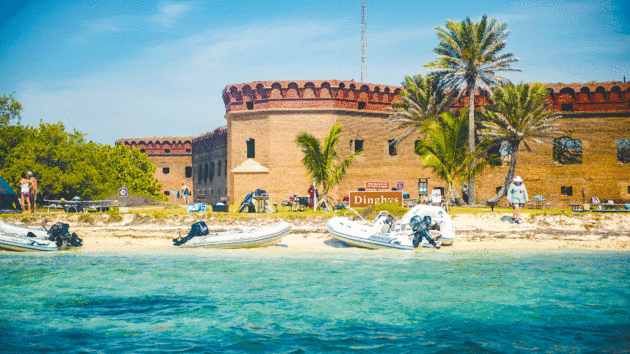
A visit to Fort Jefferson at the tail end of the Florida Keys. Photo: Kila Zamana
“My favourite place in the Bahamas is the Exuma chain of islands, because it is still not fully developed,” says Mexican cruiser Eduardo Martínez, who often sails across from Miami in his Lagoon 45, Martinsky.
“There are many ‘Virgin Islands’, many of them are privately owned but nothing has been built on them. You can anchor close to the shore and practically swim to the beach in incredible crystal clear water,” he says.
“Sailing in the Bahamas can be tricky, because there are many shallow areas. You need to navigate with care. The northern half of the Exuma archipelago is the most visited by yachts, but once you go south of Staniel Cay to Great Exuma you’ll find the majority of the islands are unspoilt and quieter. There are not many places to have dinner or to get fuel or supplies, but that’s part of the adventure. Staniel Cay is a great destination where there’s plenty to see and do.
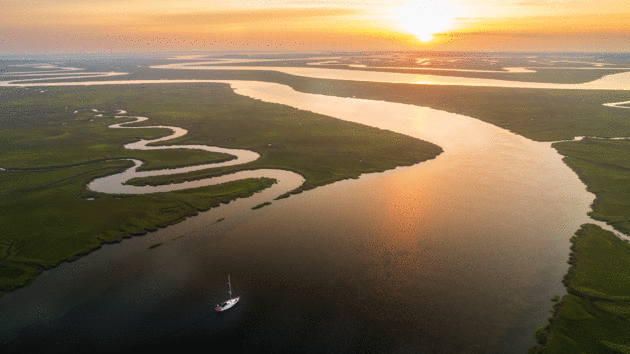
The Majors’ Beneteau 423 Fika in the Mississipi River Delta. Photo: Alison Major
“On your way there a ‘must’ is Norman’s Cay, with reefs on the ocean side. Then Shroud Cay, where you can swim with the turtles, or Big Major Cay, where you can swim with the pigs. And don’t forget to visit Thunderball Grotto where one of the James Bond films, Thunderball with Sean Connery, was filmed. There are lots of diving and snorkelling spots; a very popular one is near a sunken airplane or the Singing Siren sculpture in Ruder Cut Cay.”
The prevailing winds are from the north-east to south-east, with the most northern islands of the Bahamas lying on the edge of the tradewind belt. The islands of the Bahamas are very low, so land breezes fuelled by the warmed-up land mass are rare.
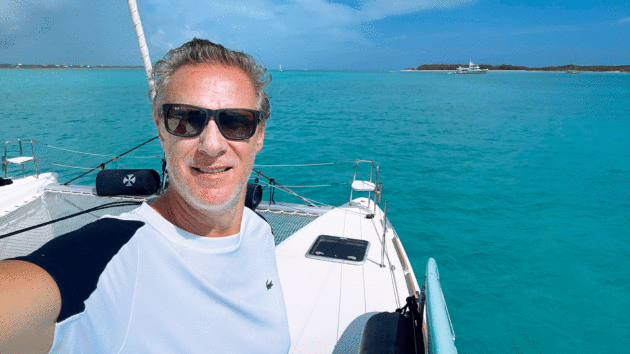
Daniel Enriquez is a seasoned Mexican cruiser aboard his Leopard 50 catamaran. Photo: Daniel Enriquez
In winter, cold fronts do occur: the wind first veers to the south and south-west, then suddenly changes to the north-west, then north – and it ends with lighter winds in the north-east before returning to the normal pattern.
The Bahamas are also prone to be hit by tropical storms: from June to November is the hurricane season, in which both hurricanes generated in the Atlantic and in the Caribbean can pass the Bahamas. Martinez adds: “They say that the best time to go to the Bahamas are the winter months, December to April, but I go any time I can. Watch for hurricane season though, and make sure there’s not one coming your way.”
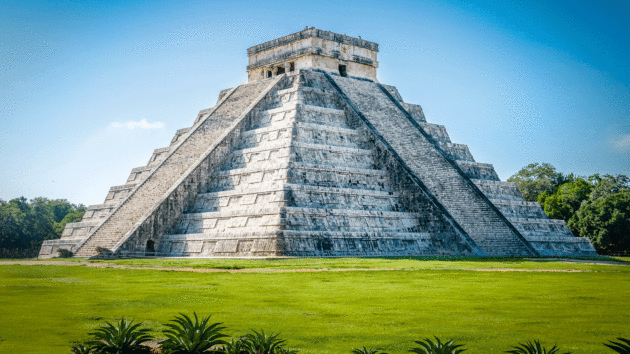
The Mayan Temple of Kukulkan at Chichen Itza on the Yucatan Peninsula, Mexico. Photo: diegograndi/Getty
East Coast USA
The Gulf Stream makes a quick trip up the east coast of the USA feasible, but why hurry? Taking it slower and going up the Intracoastal Waterway is much more fun. The ICW is a 2,600-mile inland waterway along the Atlantic and Gulf of Mexico coasts of the United States, running from Boston, Massachusetts southward along the Atlantic Seaboard and around the southern tip of Florida, then following the Gulf Coast to Brownsville, Texas.
Coastal and continental USA is outside the tradewind belt and therefore under the influence of a steady flow of high and low pressure systems. Photo: Mark Green
The eastern part has some restrictions: the maximum draught is 6ft (1.8m), the maximum height 65ft (19.8m). For taller and deeper yachts there is the option to weave in and out of the coastal waters and cherry-pick the parts that are deep enough.
First, the ICW makes your routing less weather dependent, but most of all it gives you the opportunity to explore wonderful, iconic places en route. From exciting Daytona and Cape Canaveral to historic St Augustine, and from the quiet tidal creeks in Georgia to the hustle and bustle of New York itself.
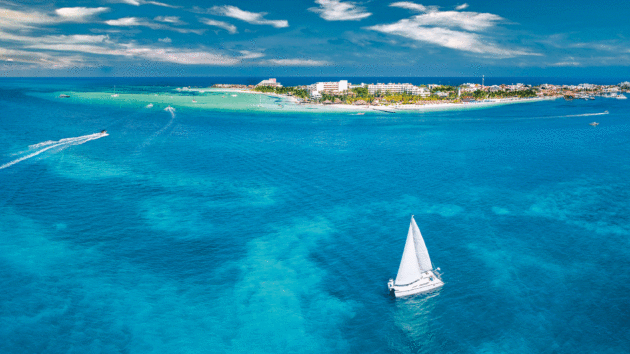
Photo: Jonathan Ross/Getty
The ICW is popular in spring and in autumn, so there is lots of information available on key navigational points, such as updates about the latest shifts in shoaling, as well as weather and current.
The best time to travel north on the ICW or offshore is in spring when the chances of northerly winds are not as high, nor is the risk of an early hurricane.
The east coast of the USA is out of the tradewind belt, so it’s best to look for a weather window in between the fronts. With a following breeze and the strong north-setting Gulf Stream, you can get champagne sailing conditions with fast and comfortable passages if you choose to go offshore. The Gulf Stream combined with a strong northerly wind is best avoided.
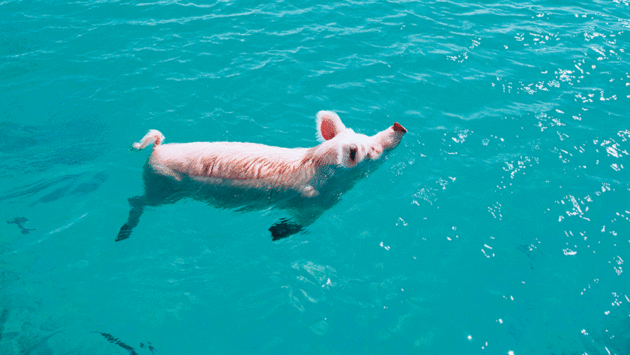
The famous swimming pigs at Pig Beach on Big Major Cay in Exuma. Photo: Cedric Angeles/Alamy
Cruising Beyond the Caribbean: America’s Great Loop
If you’re in the ICW you’ll see all sorts of pleasure craft with colourful burgees hoisted. They are Loopers: boats that travel America’s Great Loop. This is quite an unknown cruising option outside of the US, but the more you investigate it, the more intriguing it becomes.
The Loop is a clever, 5,200-mile long itinerary which connects the ICW on the south and east coast of the USA with the Great Lakes and the river system around the mighty Mississippi. It also gives you the opportunity to sail a circular itinerary.
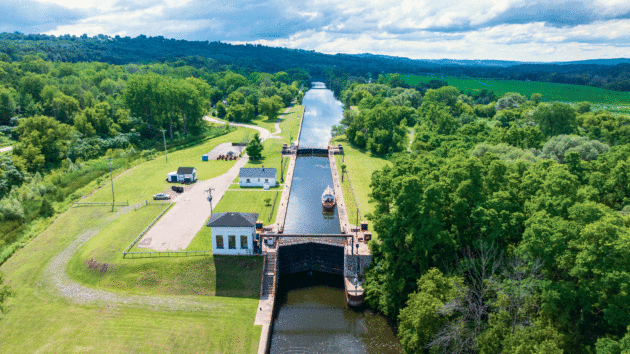
‘The Loop is a clever, 5,200-mile long itinerary’. Photo: Cedric Angeles/Alamy
American cruisers Chris and Alison Major took a year to do the Loop with their children Ewan (10) and Gwynnie (8) on their Beneteau 423 Fika. “It’s an amazing adventure, especially with children,” Alison says. “You learn so much about the history and geography of our country, while navigating the rivers, lakes and estuaries.”
Chris adds: “We started in spring on the east coast and headed north. Through the Erie Canal, we went to the Great Lakes where the sailing is phenomenal. Then on through Chicago and down the river system to Alabama in autumn. From there, we sailed through the Gulf to Florida right after the hurricane season ended. In Florida, you can go up the ICW again.”
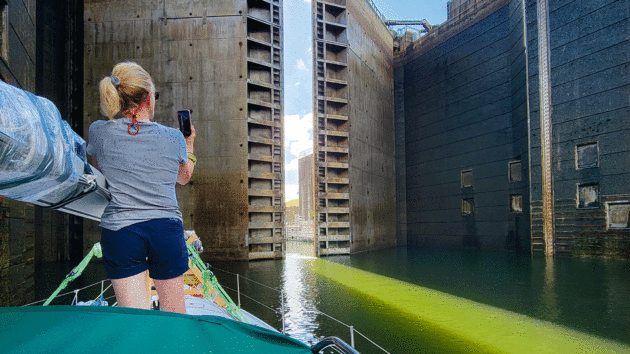
A big lock to negotiate in the Welland Canal linking lakes Ontario and Erie. Photo: Mark Green
“For us, as a younger couple, it was very easy to do the Loop in one year and keep doing our jobs remotely,” says Alison. “We thoroughly enjoyed the camaraderie between Loopers, either motorboats or sailing yachts. It’s a very helpful bunch of people, we’ve found. The ‘Docktails’ in various ports are a lovely way to meet other Loopers.”
In 2024, 270 boats completed the Loop, of which almost 50 were sailing yachts. American cruisers Mark and Letitia Green did the loop part-time, in four years with their Catalina 380 Green Voyage. “Due to work and family commitments, we opted to do the Loop in four steps. Thankfully it’s not a race and there are plenty of places to leave the boat along the way,” Letitia says.
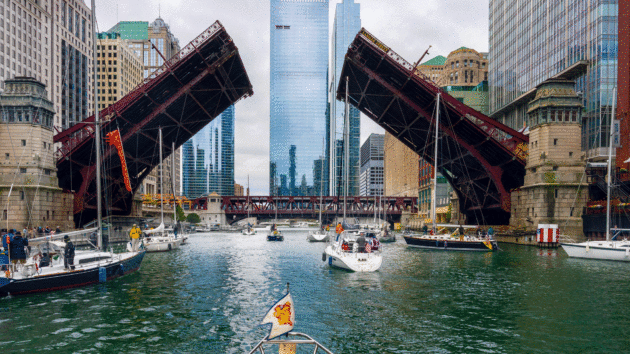
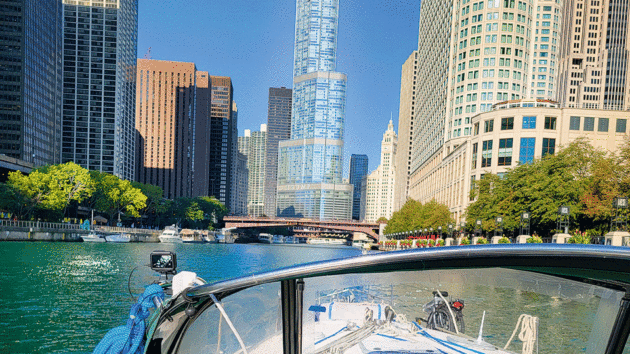
One of a series of lifting bridges allowing yachts through downtown Chicago. Photo: Chris Major/CM Images LLC
“The first winter we left our yacht in Buffalo, New York State. The second winter in Alpena, Michigan, the third at Green Turtle Bay in Kentucky Lake.
“The fun thing about the Loop is that you can choose to go off the beaten track again. In our first Loop-summer we left the Erie Canal at Oswego and made a short trip up into the Thousand Islands, then through the Welland Canal on our way to Buffalo.”
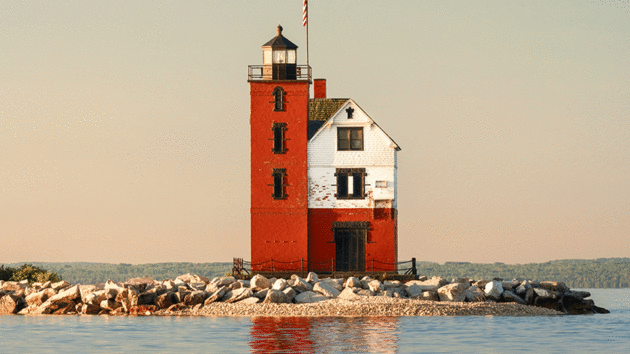
Photo: Chris Major/CM Images LLC
Mark adds: “In general, the Loop probably favours motorboats because of long stretches where you can’t sail, generally shallower draught, and no complications with masts or bridges. That said, we had some beautiful sailing in the Great Lakes and are generally more seaworthy and comfortable for passages that power boaters fret over, like the Florida Gulf crossing, and some of our longer Great Lakes runs.
“Yes, there is more motoring involved than most sailors like, but the scenery and interesting destinations along the Loop more than make up for that. Plus the fuel consumption on a sailing yacht is much lower than on a motorboat.”
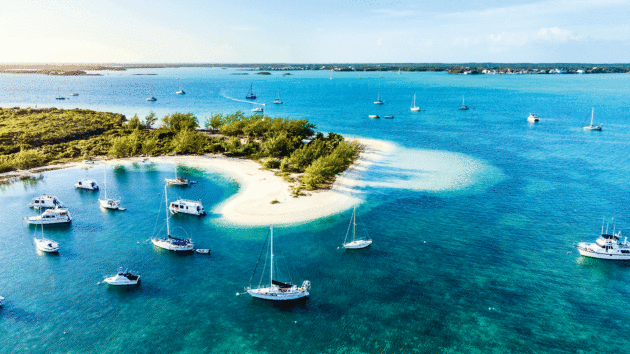
White sand and turquoise seas anchorage at Great Exuma in the Bahamas. Photo: mr-fox/Getty
There is a catch though: the Great America’s Loop has height and depth restrictions: in general, 65ft (19.8m) mast height and 5-6ft (1.5-1.8m) draught is the limit. There are two sections where the mast has to come down: the Eerie Canal and the river system south of Chicago.
Alison says: “It looks daunting at first, but there are excellent services available at boatyards along the way. For the Erie Canal, you can have the mast unstepped, but there is a DIY crane as well. We transported the mast on deck in the Erie Canal, because it’s relatively narrow and sheltered.
“For the trip south, we had the mast unstepped in Chicago and transported by truck to Mobile, Alabama. After almost two months on the river system, the mast was stepped again for the wonderful sail along the Gulf coast on to Florida.”
 If you enjoyed this….
Yachting World is the world’s leading magazine for bluewater cruisers and offshore sailors. Every month we have inspirational adventures and practical features to help you realise your sailing dreams.Build your knowledge with a subscription delivered to your door. See our latest offers and save at least 30% off the cover price.
Note: We may earn a commission when you buy through links on our site, at no extra cost to you. This doesn’t affect our editorial independence.
The post Cruising the Great Loop: ‘Whatever you decide, the ocean currents will help you on your way’ appeared first on Yachting World.