Toby Hodges takes a look at all the nominees and the winner of the best family yacht category in the European Yacht of the Year Awards

There are many categories in the European Yacht of the Year awards, from the best luxury yachts to performance yachts. But some of the most hotly-anticipated options come when it is time to choose the nominees and winner in the best family yacht category.
The European Yacht of the Year awards are selected by a broad panel of expert judges from across the globe. These are people who spend their professional lives sailing and comparing yachts, so you can be certain that the yachts which stand out in this field are truly the best of the best on the market for those looking to set out with the whole family in tow.
The race for space and value continues to override all else, and while there were features and ideas to champion, we were disappointed in how much some of these yachts cost for the quality they’re offering.
In some cases, particularly catamarans and larger monohulls, they are priced at nearly twice the ‘standard’ boat by the time you add up the options they include (options designed to give the impression of design and quality or sailing performance).
Best Family Yachts
Winner of the best family yacht 2026 – Excess 13
With sailing ability being near the top of the list of key criteria for the best family yachts, you’d presume we gave the award to the Excess for this factor alone. And in terms of connection to sailing and enjoyment, that’s correct, the Excess is in a different league (barring other nominee the Sun Odyssey). But there’s lots more to it than that!
This Lombard design is more responsive than past models, and the yard’s attention to weight, structure and stiffness ensures it not only sails well but has a good motion through waves. As our EYOTY chairman Jochen Rieker says, this stiffened structure “translates into a much more responsive feel on the helm, better acceleration in gusts and much less squeaking and rattling from the furniture down below”.
Excess has also ensured it is easy and encouraging to sail short-handed, which is another crucial aspect for family sailing.
My verdict
Engineered to a designed weight to ensure the agility to perform, it’s rewarding to sail even through big waves, all while offering more space than others in its category. It blends performance with voluminous accommodation, making it attractive for manageable family cruising.
Beneteau Oceanis 52
On the monohull side, Beneteau presented an appealing new 8th-generation Oceanis 52, a model which celebrates the line’s 40th anniversary. This powerful new Biscontini hull extends max beam aft, helping buy 30% more cockpit than the similar 51 before, and includes some stylish interior and cockpit ideas.
Some, however, such as the cramped winch positions aft, are a little flawed. We like the proper work desk adjoining the saloon and home-from-home galley, while the notable effort to improve perceived quality, using warmer trims, solid wood edges, and thicker cushions, helps make an inviting interior.
But ‘value’ becomes debatable when you consider the test boat costs €300,000 (63%) more than the standard model.
Dufour 48
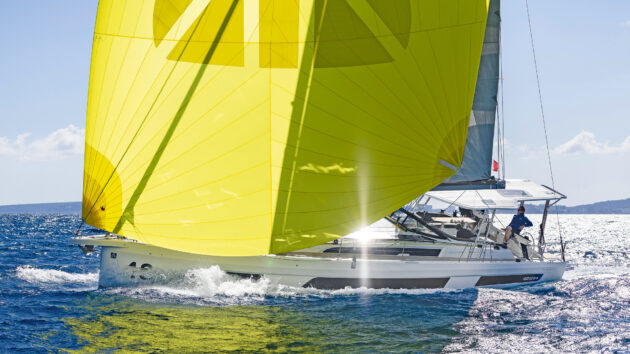
Dufour continues to chase max volume with its Dufour 48 and leads the way with deck and cockpit real estate and multiple layout options. Arguably, however, this can come at the price of comfort, enjoyment and cockpit protection while sailing. It is offered with 16 layout options, including the ability to choose different galley positions, and modules which can be heads compartments, workshops or offices.
The drawback of this volume and all the added extras is the penalty in weight (13.5 tonnes light). The test boat had the heaviest configuration with hybrid drive, hard top and davits. This solid bimini makes sense if you take the hybrid, for the 1.1kW solar benefits it brings.
The result on the water is that, like its smaller siblings in this range, the Dufour 48 prefers a breeze over 12 knots or so to come to life under sail – and yet, the tall mast needed to help encourage this, means Dufour recommends a first reef in just 15 knots true. Sure enough, when a 20-knot gust came, we were overpowered reaching with Code 0. Once up to speed, it offers good averages while white sail fetching, but remains a design more focused on volume.
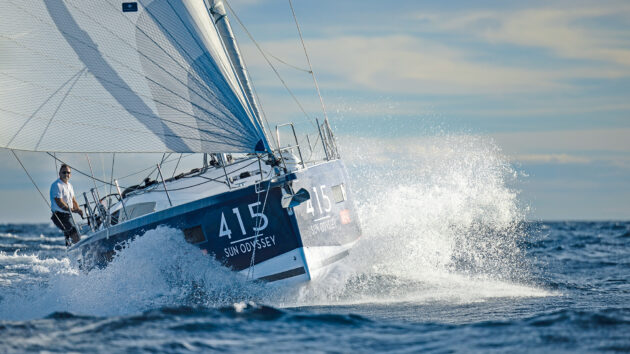
Jeanneau Sun Odyssey 415
Conversely, Jeanneau’s Sun Odyssey 415 is a blast to sail and stood out among all nominees in this regard – offering the most enjoyable sailing experience in this sector.
During my trial we scorched away from Spain, an unexpectedly thrilling sleigh ride under asymmetric kite, clocking speeds in the early double figures the whole time in complete control. The 415 offers a really engaging, sporty feel, especially for a 40ft production family cruiser, with good balance, which meant I could confidently throw it into surfs. Meanwhile, the ease, grip and control the twin rudders provide even made the long haul back upwind and into waves a pleasure.
Jeanneau had a popular platform to work with in the 410, of course, tweaking this Lombard shape, while reducing the price by 10%. Weight was removed from the layup and ‘carcass’, stowage improved, while 14cm more transom beam helped maintain the walkaround deck feature and much improved the interior layout and flow. Some areas look a bit cheap and the steering position is a little cramped.
However, if it weren’t for the fact that the jury felt it was only modifying an already very good and popular hull in the 410 rather than presenting something new, it may have merited an award.
What has been said about the monohulls here is emphasised further by the catamarans.
The majority of today’s cruising sailors are obviously continuing to seek ever more volume, whether for private use or to put into the charter market, which makes for a very competitive area for the likes of Lagoon, Fountaine Pajot and Leopard. In this space chase, however, these designs seem ungainly and high, pushing the boom up very high and creating awkward vessels in a seaway.
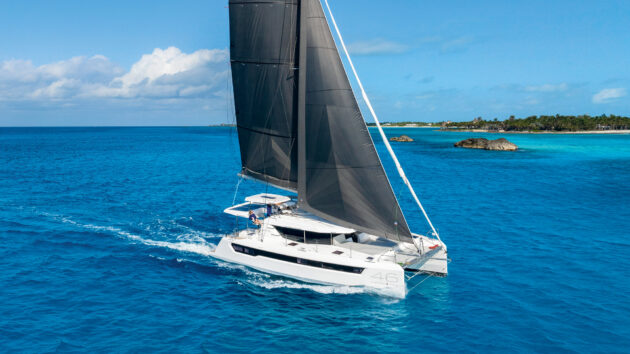
Leopard 46
That said, designer Simonis Voogd has done a good job of balancing all this volume in the Leopard 46, with its comparatively narrow bows and hulls which flare out to create lots of different social areas. And we like Leopard’s robust approach for ensuring its cats and their systems will survive the challenge of charter life (it proudly sells half its production run into the Sunsail/Moorings fleet). The target with this model was to get more performance than the 45 (380 built), hence a taller mast with 15% more sail area (albeit for more weight). Also improved is the interior layout, and the increased natural light through real glass windows.
Armed with options such as square-top main and aramid sails, a bowsprit and Code sail, the Leopard 46 can start sailing in 6-7 knots breeze. The steering felt unnecessarily stiff, but we could easily hit 8 knots with the Code or 6.5-7 knots with white sails fetching in 11-15 knots of apparent breeze.
Once again, the extensive options paint a very different picture in weight and cost to a standard boat, including the electric bathing platform (€45,000), and the €200,000 worth of 2x25kW hybrid Joool system, which pushes the cost of the test boat into seven figures.
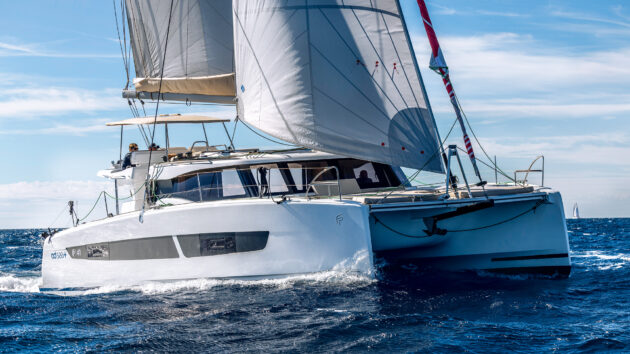
Fountaine Pajot 41
The Fountaine Pajot 41 arguably has the most inviting cockpit and interior, with its island galley, stylish furnishings and huge cabins, but the jury found the experience at sea less appealing.
The helm station, with its large bench set back away from the winches, is designed to promote family circulation and crew connectivity. It’s a position that assumes you’ll engage autopilot to trim sails and, unfortunately, the decision to move to hydraulic steering cements this, offering little connection to the sport of steering, even in the ideal 17-22 knot flat water conditions we had.
The test boat also rounded up into the wind when the regen feature of the hybrid system was engaged under sail.
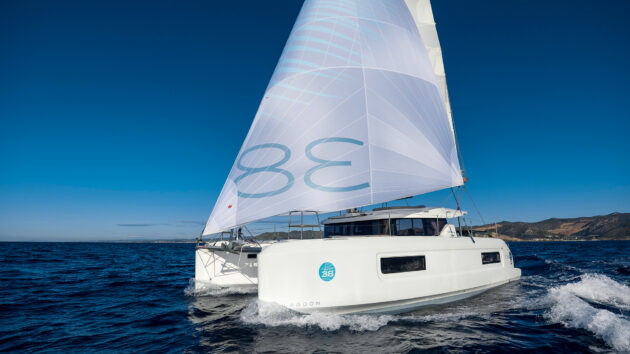
Lagoon 38
In this respect, the Lagoon 38 proved super easy to handle. I took it through some big wind and waves, including beating into them, the most challenging conditions for a voluminous cat. And while there was no masking the noises, creaking and slamming coming from the interior, it kept its way on well, making 5.5-6 knots to windward through 2.5m short period waves.
I also felt confident to solo sail the Lagoon thanks to a self-tacking jib and control lines all led to one winch by the helm – you just have to be methodical in how you use that winch. The result is that I felt completely content handling it under sail and power, including taking it back through the building surf when returning to the marina.
A smaller, simpler version of the 43 (and previous 40), the 38 suits those seeking more entry-level pricing. There’s no hard top bimini or lounge on the coachroof fly, but it does offer four same-size double berths.
Winner of the best family yacht 2025 – Hanse 360
The collaboration between the German shipyard and French design studio Berret-Racoupeau has filtered down the new range to this 360, which inherits the best of its larger sisters. Probably the largest 36-footer on the market, it’s more relatable to think of the Hanse as a short 40-footer.
Key to making it as versatile as possible in this competitive family cruiser sector is to allow owners to adapt it to suit. So plenty of options are offered, which include two or three cabins, one or two heads, diesel or electric propulsion and multiple sail, rig and keel choices.
And yet despite all that beam and volume the 360 still proved to be a pleasure under sail: easy and enjoyable, with no real concentration needed. It’s responsive and offers good communication from the
single rudder.
Granted, the upgraded Epex sails and furling Code sail made the most of the light breeze on my trial, but fellow jury members reported it continues to impress as conditions build, especially when freed-off the breeze a little, and responds well to trim.
The cockpit is generous with good coamings, while the sprayhood provided good protection during a torrential rain storm. The helming positions work and there are tailbags for sheets to keep things tidy. Below decks, there’s so much space in a clever two or three-cabin layout. The test boat had the latter, with a second heads compartment too. To facilitate this, the forward cabin has a compact double, which – although still 1.4m wide – is on a diagonal to help create space for this en-suite. It’s clever and shows how much volume there is throughout (indeed it feels so much larger than the SO350).
Elsewhere, the aft heads is a really good size, including a large separate shower compartment, and the galley can extend in the two-cabin version to include larger refrigeration.
I found it light and voluminous, particularly with the light oak Alpi trim, and a good build and finish quality for the price.
Dufour 44
The Dufour 44 is very similar to its smaller 41ft sister, which launched the year before, but with more space felt throughout. Again it uses Felci’s very voluminous hull shape, particularly in the forward sections. This helps create a vast master cabin which can boast a separate shower and heads, plus the addition of a valuable sail locker. The 44 also provides the option for a utility cabin or home office.
The result is a lot of hull to push through the water, but while testing we saw how this narrow waterline, single rudder design comes to life once the breeze reaches the teens where we enjoyed 8.5 knots under gennaker.
It’s a little cramped in the quarters but this helps buy a huge cockpit in what is a massive boat for its length.
Jeanneau Sun Odyssey 350
The SO 350, meanwhile, is the last in the line to benefit from Jeanneau’s eighth generation upgrades, a Lombard and Piaton design which sees some tweaks over the enormously popular SO 349 (1,200 sold). It’s still available with the swing keel option and is the same length, but extra beam carried aft allowed the designers to incorporate Jeanneau’s popular walkaround side decks. Still offered in the same two or three-cabin layout, the SO 350 is more feature-rich as standard, including folding prop, Corian work surfaces, more wood trim and more opening portlights.
Lombard’s design includes an inverse bow and does away with a backstay to free-up the helms.
Our test boat had the performance pack, with laminate sails, square-top main and flat deck furler. It helped produce enjoyable sailing – nothing electric, rather easy and fun. I particularly enjoyed the leeward helm position with legs extended forward and being able to stand to trim from the side deck inside the high bulwark. A fun, manageable, versatile entry-level cruiser.
Winner of the best family yacht 2024 – Bavaria C46
The Bavaria and Cossutti Yacht Design relationship continues to flourish and produce standout results in its second generation. The C46’s modern, full shape brings vast deck and accommodation space yet manages to do so on a hull which really performs for its size, and rewards the helmsman with direct feedback.
During my trial we had a good mix of conditions and were able to push the boat, a voluminous hull which becomes reactive once the breeze threatens double figures. We were able to press it during a rain squall, hitting 12 knots in 18 under gennaker, and maintained lengthy double digit spells during some enjoyable sporty sailing. Bear in mind this is a single-rudder boat, yet it still didn’t overpower or lose its grip. It’s impressive, especially given the exceptionally low ballast ratio (20%), which shows the reliance on form stability.
“The chine is a bit higher than the C42 and we tried to make the wetted surface as small as possible,” Maurizio Cossutti told me during our trial. The keel is also comparatively lighter, slimmer and deeper for a sporty feel.
It’s clear the German yard has really poured its engineering energy and might into this build – from design to engineering to finish quality, the perceived richness of the C46 stands out (although dressed with over €200,000 of options, this is still no mean feat in a mass production size and brand). So much so that other big yards may struggle to compete.
Dufour 41
You could argue the Dufour 41 does that to some extent, but here the emphasis is slightly more skewed towards volume, while it doesn’t quite match the Bavaria for the overall engineering and finish quality. Felci somehow managed to swell the forward sections enough to allow the Dufour to be the first 40-footer to offer four cabins, including two doubles forward. We then learned in September that Dufour had signed a new contract to supply Sunsail charter yachts, which helps explain the draw of all this extra accommodation space.
The price for this is extra weight. Although equipped with a tall rig, the 41 only becomes reactive once the breeze is up to the mid teens, where it can lean onto a chine and employ its generous form stability. But for those after volume, max deck lounging space and a bright spacious interior for multiple guests, it’s a hard model to compete with at this size (full report in YW September 2023 and online).

Hanse 410
On paper the Hanse 410 should perhaps have challenged the Bavaria more. It’s the latest in Hanse’s new collaboration with Berret-Racoupeau, follows on from the larger sister 460 which won this category in 2022, and shares that appealing modern hull shape. It showed respectable performance and figures, and proved easy to manage short-handed, thanks to the self-tacking jib and winches positioned to hand.
A halyard issue with the mainsail and a tangled sock for the kite curtailed my sail trials somewhat. We also found the cockpit quite busy, particularly the winch layout, although it is nice and deep for protecting its crew. It makes you query why you need two tables on a 40-footer – until you see them lowered to create sun beds, that is!
Stand out features from the interior were the number of stowage solutions, particularly on the two-cabin test boat. Offered as two or three cabins with one or two heads, the former provides a huge amount of stowage accessible from the cockpit or interior. There’s more in the galley and a multifunction space in the saloon, which can be a full length sofa berth, a proper chart table, or a standing desk with storage below.
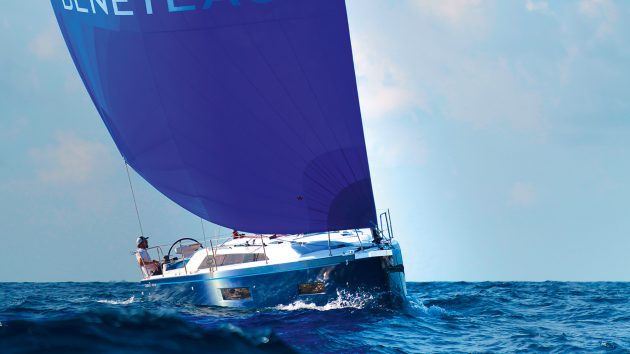
Beneteau Oceanis 37.1
The Beneteau Oceanis 37.1 is also all about easy sailing and handling, and proved to be a fun, manageable sized cruiser, particularly the First Line option we tried, which increases sail area with a square-top main and flat deck furler. While certainly an accessible yacht, it perhaps comes across as a little basic. This is the last Oceanis in the new generation eight-boat range between 30ft and 60ft, so the focus is more on evolution than the revolution of its early predecessors. Hence the two- or three-cabin interior seemed a little unremarkable when viewed against the opposition.
RM 1380
The same could not be said for the RM 1380, particularly when you step down the companionway – which doesn’t really feel like going below decks on a conventional monohull as it’s so naturally bright in the raised saloon and helps you appreciate your surroundings. So much so it’s more like being on a multihull. The doorways are a little tight, but the double cabins are of good size thanks in part to the generous beam. The standard two-cabin layout has a practical utility space in place of the optional third cabin.
I’ve long appreciated the plywood epoxy technique RM uses for its hulls, together with the powerful form stability Lombard’s design brings. This comes with the choice of keels, including the shoal draught options of a lifting centreboard or efficient twin keels. We tried the latter and the result on the water is in keeping with the sporty looks: it’s an enjoyable mid-displacement cruiser to sail from the aft quarters. Then there’s the superb winch layout, which sees the primaries positioned inboard for use standing under the protection of the coachoof and sprayhood. For offshore sailing the open transom can be closed off with a platform. It’s not perfect, but the RM is intriguing and versatile.
Elan Impression 43
Another memorable interior is to be found on the Elan Impression 43. The rustic knotted oak finish is unique, the only option Elan offers and something the Slovenian yard wanted style gurus Pininfarina to maintain to identify it from the sportier ranges. Personally, I like the strong focus on timber as it helps showcase Elan’s heritage, but appreciate it won’t suit all tastes.
These mid size Impressions are the mainstay of Elan’s sailing range, the family and charter staples for the Med. This Humphreys-designed update has a modernised shape, but retains the older style and the hull rocker to keep a soft, smooth sailing experience. It’s rigged with a genoa or self tacker and two to four winches. Although somewhat unremarkable in terms of sailing performance, it fits its purpose, while the increased aft beam allows for larger aft cabins and a service tunnel between them.

Maxus 35
In an age where we need to focus on making things last, my preconceptions of the Maxus 35 revolved around questioning the need for a lower budget Polish build. Why not just buy a proven second-hand yacht? That said, the Northman shipyard has done a respectable job on this, the largest Maxus yet, in terms of the build and finish for the price. It feels solid throughout, the interior is light and inviting and it is worth consideration as an entry level yacht with reasonable accommodation.
I can also see some appeal of the centreboard design for lake sailing. However there was little to take home with regards to the design or sailing experience, so my conclusions mirror my first thoughts.Best family yacht 2023
Best family yacht winner 2023 – Linjett 39
This is quite possibly the best boat you haven’t heard of. The 39 offers easy, fast family cruising and occasional racing in luxurious comfort and proves that classic needn’t be old fashioned.
Linjett exudes Scandi heritage: a third generation 50-year-old brand, it’s run by three brothers and has built 900 yachts from its Rosättra yard in Sweden, which dates from to the 19th Century. Its business model is based on long production runs – think evergreen rather than trendy. Linjett not only designs, engineers and builds its own boats, but services and maintains them too, with 220 in winter storage. It also now produces the high performance Shogun Yachts in carbon epoxy, which hints at the skill levels of its infusion techniques.
A telling result at sea is how quiet the yacht is. Sturdy and stable, it instils instant confidence and proved a delight to sail. We had some very pleasant upwind beats, pointing high, and some lively reaching, hitting double figures a few times while pushing it under 150m2 gennaker in waves. The Linjett is set up to easily short-hand it too, with two winches and a bank of clutches each side positioned aft in reach of the helm.
The interior is offered with two or three cabins and the latter we saw had an excellent layout, including separate shower/wet hanging compartment aft. Joiner work is first class, with traditional mahogany used as standard, or the more contemporary European Oak on the test boat.
This is a premium yacht, but you get what you pay for. It will surprise most and ensure everyone steps ashore smiling. See our full review next month.
Dufour 37
The Dufour 37 may be shorter than the old 360, but Dufour was reluctant to brand this 37 as smaller because its modern, broadened hull shape has resulted in an enlarged deck space, cockpit and owner’s cabin. Felci has designed a clever hull that sails well with good performance for its (34ft) size. The aft quarters behind the helms feel compact to maximise cockpit size, but proved comfortable enough to sail from. The primaries are in reach of the helm and we liked the lightweight, low friction jib sheet adjusters.
The 37 is offered in Easy (two winch), Ocean (cruising), or Performance versions and with a two- or three- cabin layout. The test boat was the most popular Ocean model, although it had €100,000 worth of optional extras including sails, engine and bow thruster, resulting in an expensive yacht for its length.

Bente 28
For those who recognise the Bente name, we previously featured it in detail in 2015 when it burst onto the scene with an innovative and affordable new 24-footer (around 150 of which have been built in Poland). We then tested its 39 in 2019, a year before the yard then filed for bankruptcy. But it’s now back under new ownership with this really impressive and more refined Bente 28, again by Judel/Vrolijk.
It’s a fun yacht to sail, easy to short-hand, with sprightly performance, especially when reaching. The coachroof is part of the deck structure and proves crucial in providing light, space and headroom below in an ergonomic interior that has been very well thought out.
All in all it’s a great compact, entry-level cruiser, with a practical, well protected cockpit.
 If you enjoyed this….
Yachting World is the world’s leading magazine for bluewater cruisers and offshore sailors. Every month we have inspirational adventures and practical features to help you realise your sailing dreams.Build your knowledge with a subscription delivered to your door. See our latest offers and save at least 30% off the cover price.
The post Best family yacht 2026: Adventures with the whole family appeared first on Yachting World.