Is seasickness all in the mind? Nobody who’s suffered can doubt that it’s a real, physical problem. But could a new ‘brain training’ approach offer a solution? Kristina Rechenbach explains all
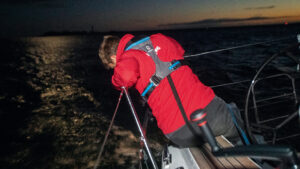
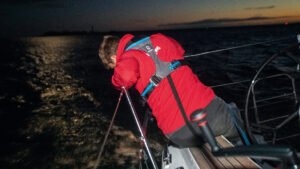
Seasickness is surprisingly common – around one in three people are estimated to suffer from it, including long-term cruisers and even professional sailors. While numerous remedies and medications offer temporary relief, they often fail to address the root causes.
Norwegian psychologist Thomas Bickhardt believes that understanding and mitigating seasickness involves complex interactions between perception, the nervous system, and individual experiences. He spent 30 years researching with professional seafarers on Norway’s harsh west coast to understand the phenomenon. Bickhardt founded the ‘TilliT’ Institute in 2022 and now teaches a new approach to overcoming seasickness, known as the TilliT method.
An unsolvable problem
From my very first sailing experience I loved being at sea – the sun on my face, the wind in my hair, and the disconnect from everyday life. But seasickness was my constant companion from the outset. I experimented with various medications and home remedies, and sought advice from every sailor I encountered. The old seafarers’ adage that seasickness subsides after a few days simply didn’t hold true for me.
As I sailed more, I meticulously observed my triggers, considered hull shapes and sizes, scrutinised weather forecasts and routes. Some strategies provided temporary relief, but I never fully overcame the issue.
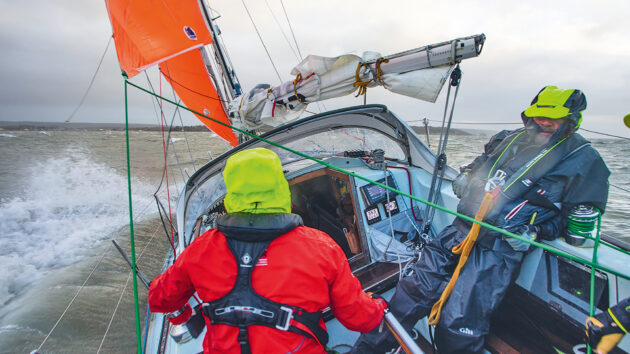
Being on deck in fresh air with a view of the horizon – whatever the weather – can often help lessen seasickness symptoms. Photo: Richard Langdon/Ocean Images
I adapted by structuring my onboard routine to minimise time spent below deck. Every trip to the heads, every meal, every course change was precisely timed. Unexpected changes in conditions were difficult to manage. My skippers and crew were always aware of the risk and supported me when I became incapacitated. But despite their support, I often felt like a burden. My inability to resolve this issue was deeply frustrating and draining.
Nervous confusion
Our nervous system relies on multiple sources of information to maintain balance. It receives input from the vestibular system – the inner ear and body receptors – that perceive orientation and movement. Visual information also plays a crucial role. Experiences build perception: when our eyes see a room with straight lines – doors, windows, furniture – the brain assumes we are in a stationary building.
When these signals to our brain are conflicting – for example, below deck on a moving yacht – the nervous system will react. The eyes signal a stable environment, while the vestibular system detects motion. This discrepancy triggers a survival mode leading to seasickness symptoms in
some sufferers.
Article continues below…

Seasickness cure: Could VR be the future?
A true seasickness cure has long been hoped for as the debilitating problem has followed sailors for centuries. Charles Darwin…
The TilliT Method
When I first learned about the TilliT method I was sceptical, but at that point I was desperate for a solution. I had planned a solo circumnavigation of the Baltic Sea the following summer and was willing to try anything in preparation.The TilliT method firstly teaches sufferers how to maintain balance without relying on the visual system – or in other words, your eyes. This is taught through practical exercises, and is designed to eliminate conflicting signals and therefore prevent symptoms.
Secondly, participants need to understand how their personal experience of seasickness can trigger a trauma response – even once the practical exercises have been mastered – and how to deal with that.

Stugeron is a well-known seasickness medication, but doesn’t suit everyone
Thirdly, participants learn how to calm the nervous system response when it is triggered. Our nervous system always wants to save us and by default believes we shouldn’t be this far away from the safety of the shore.
Learning to maintain balance without relying on your eyes is done on customised balancing boards. Participants start by trying to keep their balance and are eventually challenged through verbal and visual distractions. This way they learn to notice where gravity pulls within their body and to maintain their balance without using their eyes, often within minutes.
Participants are then taught ways they can repeat this exercise to the same effect once on board a boat. This way the newly learned skill is trained like a muscle. In order to be successful, participants need to repeat this exercise frequently on their own until they are secure in the process.
Practice Makes Perfect
After taking part in TilliT training, I joined a small regatta as a crew member and started applying the exercises. Each day after setting sail, I performed my balance exercises for about 15 minutes below deck and quickly noticed a difference in how I moved on the yacht, how I kept my balance, and how my confidence shifted. I became more mindful of how my body reacted to changing surroundings.
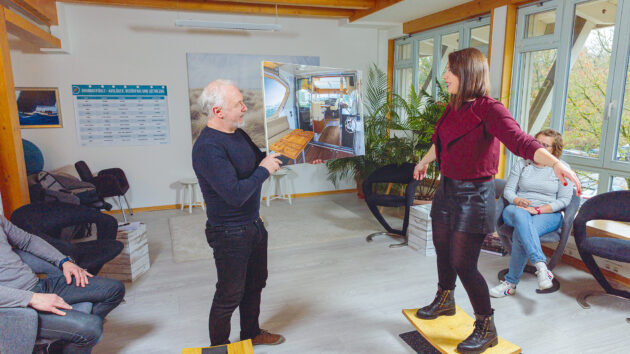
TilliT training programme psychologist Thomas Bickhardt gives instruction in learning to maintain balance without using your visual senses. Photo: TilliT Institute
The biggest challenge was practicing these techniques among seasoned sailors who had never experienced seasickness. It is hard for those who have never been seasick to understand how debilitating it can be. Practicing mindfulness and finding balance within can seem very far fetched among this group. However, I embraced my vulnerabilities, and the rest of the crew were good sports about it – especially once they could see the improvements. By the end of the trip, I was cooking below deck, overjoyed by this simple yet newfound capability.
Shortly after, I embarked on my Baltic Sea circumnavigation, only to be confronted by how psychological aspects impact seasickness. I had just overhauled my entire life: a long-term relationship had ended, I had quit my job and packed up my home to travel for months. While these changes marked the beginning of a grand adventure, they also brought uncertainty, instability, and stress. I started out on my trip practicing the balancing exercises as usual. A few hours in, I didn’t realise how tense I was until I found myself throwing up over the railing.
Mind over matter
The second, equally important component of the TilliT method addresses psychological and social factors. Previous negative experiences and stress can influence seasickness just as much as conflicting signals within the nervous system. Factors might include poor crew morale, unresolved personal conflicts, hangovers, or – as in my case – major life changes.
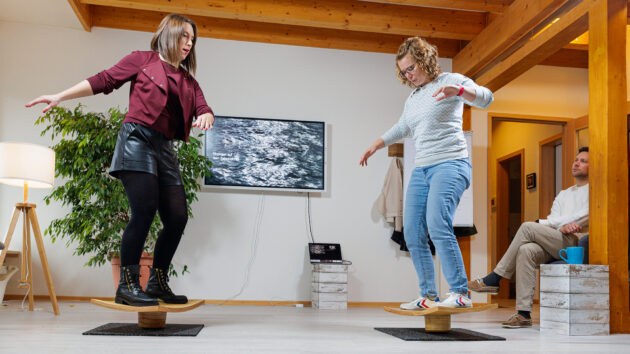
Kristina Rechenbach practices her balance exercises. Photo: TilliT Institute
This is not unusual, Bickhardt explains, “Triggers of seasickness are often amplified by psychological processes linked to our negative experiences with rough seas.”
Negative conditioning means we can also associate smells, sounds or movements with experiencing seasickness. Our brains can store a connection of seasickness with minor details in a complex system of hippocampus, insula and amygdala. Past experiences shape our perception and lead to rapid, instinctive reactions. This has an evolutionary benefit: seeing patterns helps us recognise dangers promptly and respond swiftly in threatening situations. However, these same mechanisms may potentially trigger survival responses when no real danger exists. So it’s crucial to learn strategies to overrule these instinctive reactions and remain in control.
During TilliT training participants are invited to understand their individual psychology. While this is not an issue for everyone, it can help some find relief, and all participants learn to recognise and manage psychological stressors.
A key part of this also lies in changing a sufferer’s mindset from being a burden to the rest of the crew to an actively participating sailor. “In treating seasickness, my goal is to help individuals shift from victim mode, to an active stance of ‘taking action’,” adds Bickhardt.
System shut-down
When you are sailing and having a good time your nervous system is in a relaxed state. But when the activity becomes seemingly more dangerous we move into the ‘fight or flight’ response. This is a normal reaction and allows us to take action and still make conscious choices.
However, when the danger is perceived as life-threatening the nervous system takes over to ensure survival. This can result in a complete system shut-down known as the freeze response.
The stress level that leads to your nervous system shutting down and aiming for survival is individual and highly dependent on your personal experience. The more often you have been seasick the sooner it will shut down without intervention. At its most extreme, sufferers can experience debilitating seasickness on a jetty before even setting foot on a boat.
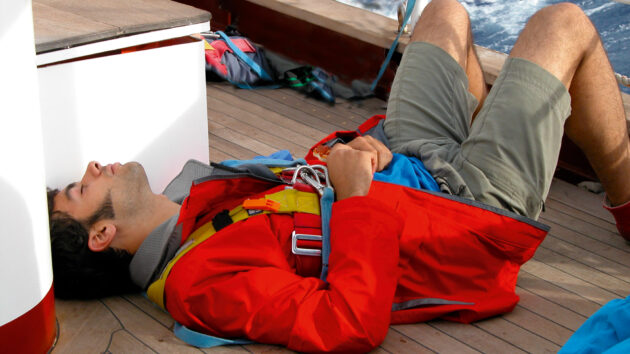
Seasickness can be completely debilitating, rendering crew unable to help out with sailing duties. Photo: Will Bruton
“Seasickness results from the nervous system’s honourable attempt to keep us alive in a perceived life-threatening situation. We need to teach [it] that the boat’s movement isn’t life-threatening,” says Bickhardt.
Part of TilliT training includes ways to regulate the nervous system, one of which is the ‘basic’ vagus nerve exercise developed by osteopath Stanley Rosenberg (there are lots of videos on this online). This can be used before sailing to create a sense of calm, though it also works while you’re underway.
Managing instincts
By observing myself and understanding patterns, I learned to manage my instinctive reactions better. Sailing alone forced me to tackle them quickly: in rough weather, I couldn’t indulge in self-pity, I had to act to ensure my own safety. Over time, I found that I no longer experienced seasickness, even in stressful situations. At times I would fall back into old patterns, but the tools I’d learned helped me move myself out of them.
Subsequently, I began skippering holiday passages in the Mediterranean. On some of these trips I met people who, like me, loved the sea but struggled with seasickness. This inspired me to become a TilliT teacher. I remember the moment I was overjoyed to finally slice tomatoes in the galley: a seemingly small act that symbolised a huge breakthrough. The immense relief of standing below deck comfortably was profound. At last, I could truly enjoy life at sea.
 If you enjoyed this….
Yachting World is the world’s leading magazine for bluewater cruisers and offshore sailors. Every month we have inspirational adventures and practical features to help you realise your sailing dreams.Build your knowledge with a subscription delivered to your door. See our latest offers and save at least 30% off the cover price.
Note: We may earn a commission when you buy through links on our site, at no extra cost to you. This doesn’t affect our editorial independence.
The post How I finally conquered a lifetime of seasickness to become a yacht skipper appeared first on Yachting World.