After 135 years, one of the oldest trophies in American sport has finally changed hands. Eric Kane and Helen Fretter report
To understand what happened in Red Bank, New Jersey, in the first 10 days of February this year, you first have to understand the cold.
This wasn’t a regular winter. This was a freeze for the ages. A polar vortex settled over the US North-east like it had nowhere else to be, sending wind chills plunging to 20 below zero and locking waterways in ice that hadn’t been this thick in decades.
The Hudson River froze. The East River froze. New York Harbour froze. NYC Ferry suspended all routes. The Seastreak ferry – a lifeline for Jersey Shore commuters heading to Manhattan – needed a tugboat to crush a path through the ice in front of it just to make its daily run to the city.
Rivers that normally flow became roads. Bays that normally ripple became glass. The Navesink – the wide, tidal river that curls through Red Bank like a signature – became something it hadn’t been in over 20 years: a frozen stage for the oldest trophy race in American ice yachting.
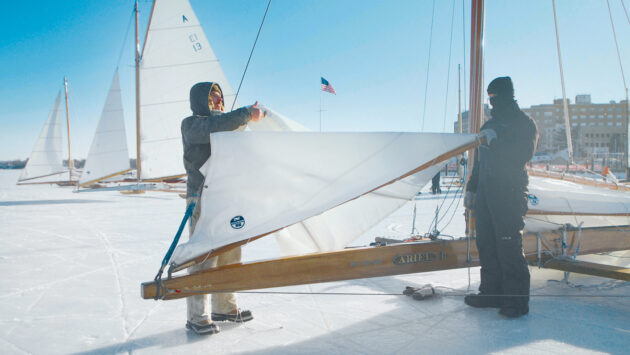
Rigging the gaff -rigged A Class on the river. Photo: Timothy Stanton
Home of ice yachting
Ice yachting on the Navesink River isn’t a novelty. It’s rooted deep in the area’s heritage. In 1856, pioneers launched the first ice boats on this river, experimenting with three-runner and four-runner designs, lateen and gaff rigs, testing what worked and what didn’t on the frozen surface of what many consider the most beautiful river in the country.
What they started never really stopped. In 1880, Dr Edwin Field and a group of Red Bank sailors founded the North Shrewsbury Ice Boat and Yacht Club on the river’s south shore, where it has stood for nearly a century and a half.
Between 1900 and 1910, Thomas Edison brought his cameras to the club to film the ice boats – short, silent films that captured Red Bankers gliding across the frozen Navesink in vessels that, at the time, were the fastest things on earth. Those films are now in the Smithsonian.
Families have sailed their trademark designs on the river for generations. In the 1990s revolutionaries broke new ground with carbon fibre designs and cockpit canopies that pushed ice boats into a new era of speed. This is not a place that picked up ice yachting as a trend. This is where ice yachting lives. And at the centre of all of it sits a silver cup.
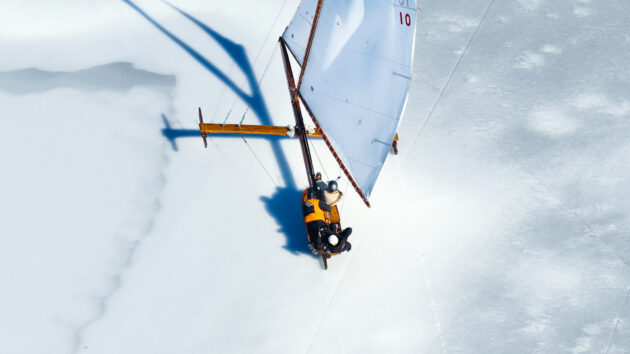
Practice sailing three-up with a videographer to capture the raw speed. Photo: Anthony Trufolo
In 1886, wealthy Hudson Valley ice yachtsman Gardiner Van Nostrand commissioned Tiffany & Co to create a unique cup for ice boat racing. It was to be held by the winning club and defended whenever challenged.
The Van Nostrand Challenge Cup of America is, without exaggeration, the America’s Cup of ice yachting. When it was last appraised during the 1978 race, the Tiffany silver trophy was valued at $20,000 – the equivalent of roughly $100,000 today. For most of its life, it has been locked inside a bank vault.
The North Shrewsbury Ice Boat and Yacht Club won the cup in 1891. They defended it successfully in 1978. They defended it again in 2003, in a race The New York Times called ‘possibly the oldest and longest-deferred grudge match in sports history’. After each defence, the cup went back to the vault. Safe. Untouchable. For 135 years, the cup never left Red Bank. Until the second Monday in February.
Article continues below…
Smallest boats: The bonkers world of Microyacht adventures
Often the smallest boats to cross oceans look much like a child’s crayon picture of a little boat on a…
Challenge accepted
Word swiftly spread that the Hudson River Ice Yacht Club had issued a formal challenge, and that the North Shrewsbury club had accepted.
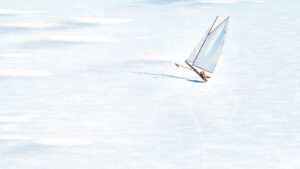
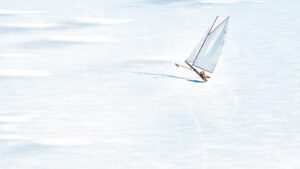
The Van Nostrand Challenge Cup is raced in A Class ice yachts dating back to the 1880s. Each yacht is 9-10m in length, with a gaff rig, built to a maximum sail area rule (350ft2). Known as ‘stern steerers’, they have three runners: side runners just under 1m long, and a smaller aft runner that is the rudder blade.
Most of the boats are original, built of Sitka spruce and Douglas fir, with cast steel runners set into a white oak housing. Where once they carried Egyptian cotton sails, they now fly Dacron, some Harken blocks swapped instead of traditional bronze to cope with the increased loads. Otherwise, there are few concessions to modernity.
Sailors from Hudson River trailered their lovingly restored 19th-century yachts down from New York State, including the Ariel, a stunning wooden vessel built in 1887. Ariel was helmed by Luke Lawrence, a fourth-generation member of the Hudson River club and a pro racer who has won J/22 and J/24 World Championships, and junior Finn and Star world titles.
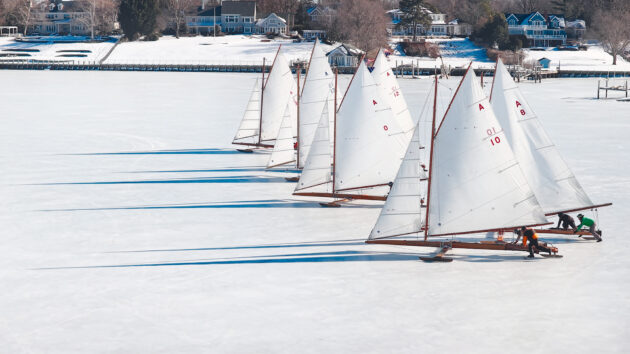
Ariel (sail no. 10) drawn to start on the inside, which requires holding a high lane off the start line. Photo: Joe Malley
His long-time friend, Max Lopez, tended the mainsheet. Lopez grew up sailing on the waters of the Navesink and knows the wind patterns over the river better than the twisting jughandles of New Jersey’s Route 35. When not racing, he lives and sails aboard a 1984 Pearson 530 ketch (he and his partner, Abby, share cruising adventures on YouTube @Sailing.Everyday).
Lawrence and Lopez have raced with and against each other in ‘softwater’ sailing many times, but never actually iceboated together. They met up to train around a decade ago, but winds were too light. “We sat around for four days waiting for wind. But we got practice pushing!” recalls Lawrence.
In fact, it is so rare that conditions align for perfect iceboating, even Lawrence – who first went out on the ice with his dad aged four – has just a handful of days behind him in his mid-30s.
“It’s a very difficult thing to have the circumstances line up to even let it happen. I’ve done it less than 10 times in my life,” he explains.
If the weather does allow for iceboating, opportunity is limited due to the sheer physicality of sailing the massive boats in sub-zero temperatures.
“Just being out in those conditions, if you practise for an hour, you feel like you just did three days of softwater intense training,” says Lawrence .
For The Van Nostrand Challenge Cup six boats would race: three from each club, on a mile-long windward-leeward course, three laps per race, best of three wins to claim the cup. But nature had other plans.
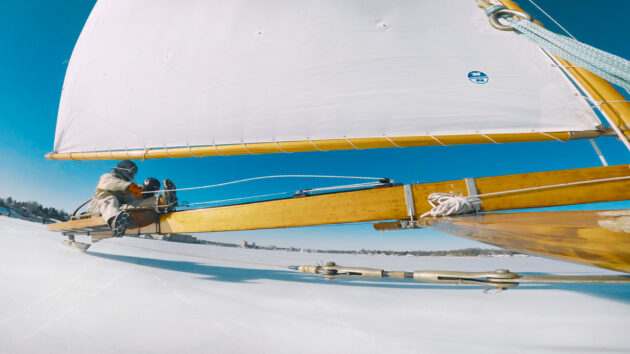
Photo: Timothy Stanton
The preceding week brought ice so thick you could drive a truck on it – but winds so light the massive sails barely rippled. The boats sat motionless. The sailors waited. Saturday and Sunday swung violently in the other direction: gusts topping 50mph tore across the river, far too dangerous for huge boats with no brakes that can reach speeds of six times the wind. Race after race was scratched. The anticipation built. And the crowds grew.
On the Navesink thousands of people poured onto the ice that weekend. Hockey games broke out as the moon and Jupiter rose over Red Bank in tandem. Cyclists pedalled where fish normally swim. Parents pulled children on sleds where 100-year-old ice yachts were being rigged. Families walked to the middle of the river just to stand and look around at their town from a vantage point that doesn’t exist in any other season.
Photographers and drone pilots captured what no previous generation of ice boaters had ever seen: the long afternoon shadows of 19th-century sails stretching across the rippling ice. Footage of practice laps ripped across social media, making Red Bank the centre of the winter sports universe. A little known trophy that has been raced for just four times in 140 years became a phenomenon.
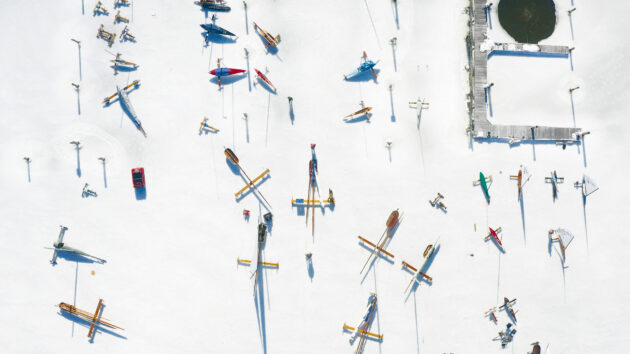
The A Class challengers were joined on the ice by singlehanders and other fleets, as well as ice hockey games and local families enjoying the spectacular deep freeze. Photo: Timothy Stanton
Wrestling a bear
On Monday 9 February the wind finally settled into something workable – enough to move the big boats, not enough to flip them. The morning was bitterly cold, but the ice was perfect. About a mile from the clubhouse, six boats lined up to race, starting with a boom from a miniature cannon.
There are highly technical elements to racing A Class yachts. Ariel was fitted with runners that Lawrence’s grandfather had optimised for the Red Bank ice, which is different to the freshwater of the Hudson.
“You can pick the steepness of the angle of the blade,” he explains. “The difference is the harder the ice, the more grip you need to have. So you go sharper and sharper.
“In New Jersey it’s saltwater ice, so the freezing temperature is significantly lower. As soon as the sun hits that kind of ice, the top surface starts getting like sherbert. It’s really grippy and draggy. Our sharp runners cut in a lot, and it’s really slow. I knew that from hearing my grandfather talking about it over the years. So I switched that morning to [a more angled blade], which was a massive improvement.”
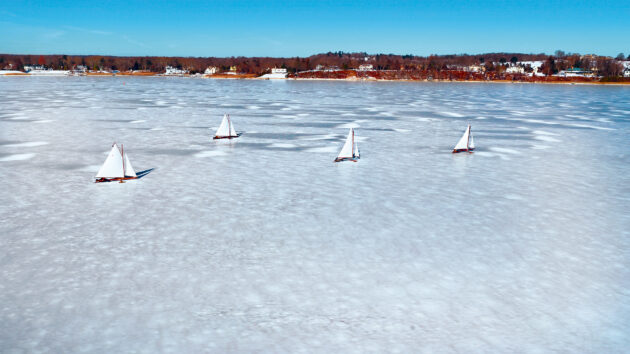
Tthree boats represent each club in the Van Nostrand Cup. Photo: Joe Malley
But it is also enormously physical. Racing begins with both crew sprinting to push their yachts like Olympic bobsled teams, before leaping into the moving vessels.
“We took an early lead because we were just younger and had athleticism on our side – Luke’s gigantic and a savage!” recalls Lopez.
“Then right off the rip, I started pulling in the sail really hard. The mainsheet is a freaking bear, it’s ridiculous.
“Trimming is non-stop, full on. You’re holding on to an 80lb weight, and you have to keep pulling it in and letting it out, pulling it in and letting it out. I would describe it as brutal.”
Despite the yachts’ elegance, the ride over the ice is not smooth. “It’s more like you’re wrestling,” says Lopez. “You’re trying to stay on a wild horse and trim a gigantic mainsail. And with the rudder in the back, you’ve got to remember that this blade is close to 3ft, and it’s digging into the ice, with just a big brass handle. It’s 1-to-1. There’s no mechanical advantage for the guy driving.”
Without visual clues to see gusts on the water, staying in pressure becomes key. “We have telltales, and we’d done some hot laps before, so you get a feel of where you are on the lake – a blue house, a flag pole up at the top of the course, you pay attention to those clues. Then it’s really a lot of flow sailing,” explains Lawrence.
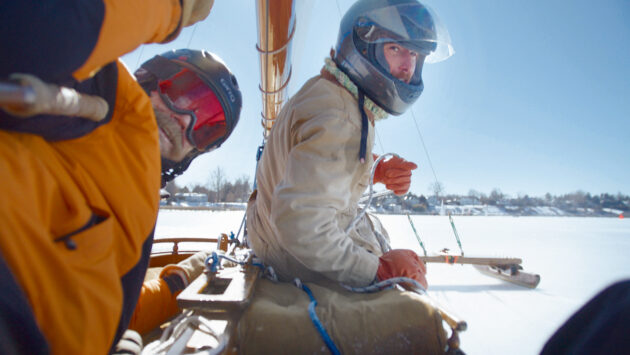
Crews wear motorcycle helmets and multiple layers for protection, but race times are short in the severe wind chill. Photo: Timothy Stanton
“The goal is just to keep the boat ripping. You never want to under-tack the layline in one of these things because then you set yourself up for a slow bear away, which turns into a slower run. So you do everything you can to preserve your momentum around turns and through lulls. The boats weigh almost 500 kilos.”
At one point Ariel ended up behind champion iceboater Dan Clapp. Lawrence sailed high in search of a gust. “I was trying to get over to a spot where the pressure kept coming down through this little gap at the top of the river. That puff had been coming through right in the exact same spot the entire day because you could see some wipe-out marks on the ice where it had caught a couple of people off guard and their boat spun out, and that leaves little scars.
“As soon as we hit those scars, the breeze started filling right on cue and we kept bearing away. Then it was just one gybe around the mark and another gybe into the finish, and that was it.”
Lawrence and Lopez in Ariel won the first heat. Then the second. The best-of-three was over in straight runs.
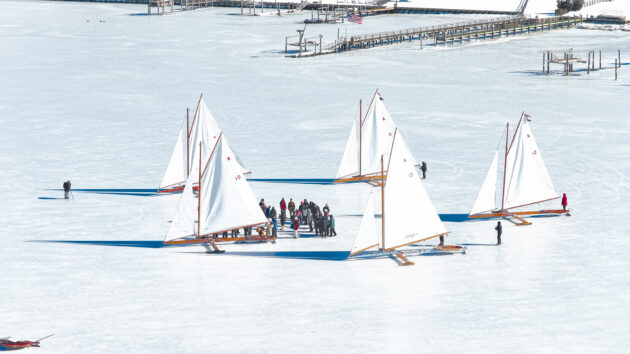
The antique A Class ice yachts were once the fastest things on earth – and can still challenge the very fastest craft of today for outright speed. Photo: Anthony Trufolo
As the Ariel slid to a stop after that second victory, the pair embraced in hugs and high fives with friends and family who rushed onto the ice.
For a moment Lawrence knelt silently in the Ariel’s basket, taking a quiet, private minute amid the hoots and hubbub. “I did this one for ‘Pop Pop’,” he said when he stood. “He won a lot of stuff, but never this one. So this one is for him.”
Luke’s grandfather, Bob Lawrence, was a boatbuilder and sailor. “This is all so much bigger than me,” he says. “My grandfather raced for it in 1978 and didn’t win. And then my dad and my uncle and my cousin raced for it in 2003 and didn’t win.
“I’m the third generation that’s been trying to win this. It all comes down to the support of my family that keeps these boats alive, that keeps this dream alive.”
After 135 years of dreaming, the Van Nostrand Cup is heading to a new home…
Until the next challenge.
 If you enjoyed this….
Yachting World is the world’s leading magazine for bluewater cruisers and offshore sailors. Every month we have inspirational adventures and practical features to help you realise your sailing dreams.Build your knowledge with a subscription delivered to your door. See our latest offers and save at least 30% off the cover price.
Note: We may earn a commission when you buy through links on our site, at no extra cost to you. This doesn’t affect our editorial independence.
The post Long read: A polar vortex, the thickest ice seen in decades on The Navesink, a $100,000 Tiffany and Co. trophy, and the ‘longest-deferred grudge match in sports history’ appeared first on Yachting World.