Toby Hodges takes a look at all the nominees and the winner of the specialist yachts category in the European Yacht of the Year Awards
What do you do when you have yachts that are as diverse as innovative daysailers, a lake sportsboat, a recyclable one-design and an elite high-end carbon weapon? Well at the European Yacht of the Year Awards, we define them as specialist yachts. And this year’s eclectic bunch of nominess for the best special yacht really were full of interesting new ideas.
Where other categories in the awards such as the best family cruisers, best bluewater yachts, or best luxury yachts are made up of boats that are similar in terms of their usage the best specialist yachts category has a plethora of options, all of which have found a new, interesting or otherwise noteworthy design direction.
This year’s eclectic bunch of nominess for the best special yacht really were full of interesting new ideas.
Best specialist yachts 2026
WOY 26
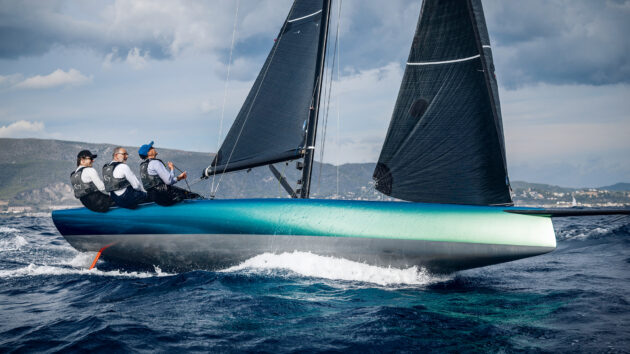
This stunning design could only be born from a sailor’s passion – in this case, Jan Brügge and his desire to show wood still has its place in modern boatbuilding. The Woy 26 proves you can blend timber with the latest materials and techniques to create not only a sustainable product, but the most striking new yacht afloat.
I actually caught my breath just looking at the Woy in the marina, as the early morning sun reflected off the metallic coloured, rocket-like hull. It’s a new level of definitive sailboat cool – kudos to Martin Menzner of Berckemeyer Yacht Design. It’s contemporary yet timeless, with a flat run, planing hull with reverse stem, open transom and lifting T-keel.
Looks aside, the construction is a story in itself. Built by Jan Brügge Bootsbau on Germany’s Baltic coast, the lightweight hull uses vacuum-glued, locally selected softwood veneers. Brügge has taken a cold-moulded-type technique and added new infusion methods to demonstrate that tropical hardwoods aren’t necessary. Pine, larch and silver fir are used along with some composite parts, such as the rudder and engine box for the electric propulsion.
Exquisite detail and craftsmanship of course comes with a handsome price tag. But the Woy is not just a lake sailer or racer. During test week it won the jury’s hearts on the water. Even the big stormy day didn’t deter them from sustained (wet) joy rides. As luck would have it, I was given a breathless morning trial – so we’ll feature more on this boat soon.
My verdict
A sublime, sporty yet manageable daysailer or racer, the Woy 26 shows that wood rules – it’s both the past and the future!
Tortue 147
What else could you call a category comprising the most extraordinary yacht I’ve ever boarded and a sublime wooden art form in the shape of a daysailing/racing weapon? Special indeed.
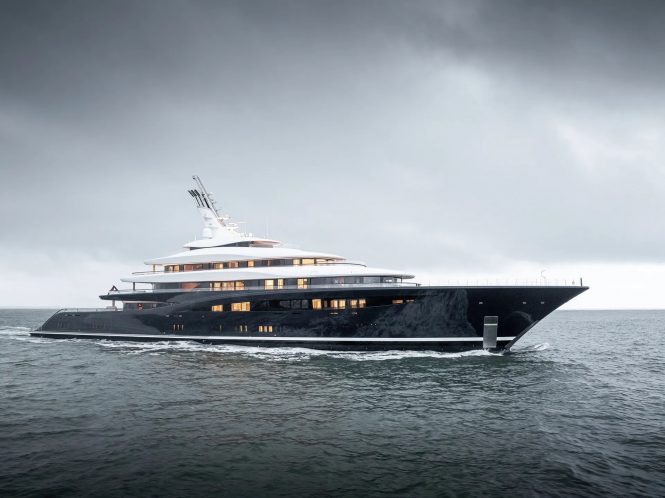
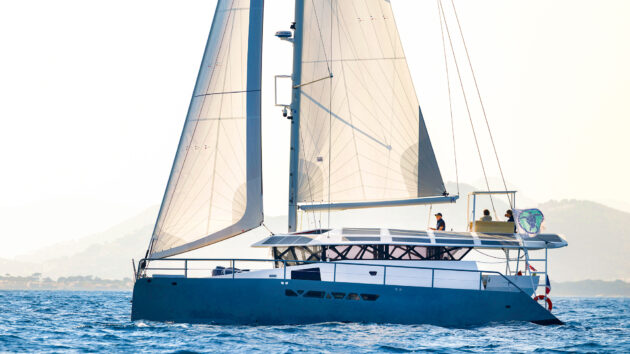
That truly extraordinary yacht is the Tortue 147, an aluminium cat we asked to come to the trials, thinking it could be in line for an innovation prize – and because the jury were so curious to see such a different design in person.
Unfortunately, very few of us could ascertain what it is like to sail, as it spent the majority of the trials tied to the dock, awaiting a spare part for an engine. However, we did feature this Tunisian-built alloy cat in our December 2025 issue, after François Tregouet sailed her in light winds last summer.
Personally, just spending time on the Tortue was an unforgettable experience. Having toured hundreds of new boats, if not thousands, during the last three decades, this stands out for its quirkiness, yes, but also how crammed it is with original thinking.
Without repeating François’ detailed article, my highlights include the layout and blend of arty architecture, which is framed with sustainable timber and makes the cabins feel like you’re in a fairy tale treehouse; the awesome hanging chair of the navstation; and the aft cockpit saloon which appears to float above the water.
For those in a hurry, the turtle boat may not go anywhere particularly quickly or efficiently. But the fact that it hosted drinks for 20+ people yet didn’t feel remotely crowded shows just what a social platform this presents at rest.
It is more prototype than production though, like a mad professor’s sketchbook of ideas. But for those who may choose to scoff at the design, consider this: for anyone who boards La Tortue, it instantly puts a big grin on your face, which stays with you. And that’s worth celebrating!
Best specialist yacht 2025 – Bay cruiser 21
There is an increasingly small choice of new entry-level yachts, but Swallow Yachts has produced a multifaceted beauty here. Attractive and seaworthy, with space to host friends or for a couple to weekend aboard, the Bay Cruiser 21 also offers engaging performance, shoal draught and easy towing ability.
The generous cockpit has deep coamings and a protective coachroof without impairing vision from the helm. A lightweight carbon mast and boom, Dyneema standing rigging and halyards and water ballast all come as standard to help with weight, power, stability and speed of rigging. At just 600kg the Bay Cruiser 21 is light enough to tow easily behind a normal car and can be rigged in minutes. In fact, we timed designer Matt Newland doing it alone – 31 minutes from arriving under sail to driving home!
We sailed it empty in light winds, relying on just the 25kg of lead ballast in the swing keel. An electric or hand pump is used to add the water ballast when in more breeze, flooding the single tank in the bilges to provide 400kg extra stability.
It then offered dry, double-digit surfs the following day in strong winds (extra purchase for the mainsheet would help though).
We liked the focus on balance and stability. The 6hp outboard is mounted forward in the cocckpit to help centralise weight, which also means the prop thrust is directed over the rudder blade. The swing keel and kick-up rudder setup also means you can dry out easily too.
The interior is compact compared to the cockpit, yet provides a comfortable seated area, enough room to sleep two and a dedicated space for a chemical heads.
In an age where new entry-level yachts are almost obsolete (and all cost six figures), this is a proper little cruiser which offers so much for the price: light weight, easy sailing performance, in a classic shape with a generous, protected cockpit and a weekendable interior. And you can tow it anywhere and rig it in minutes. For those who worry about the future of sailing, check out this Welsh yard. A unanimous hit among the jury and a standout yacht of the year.
Tofinou 7.9
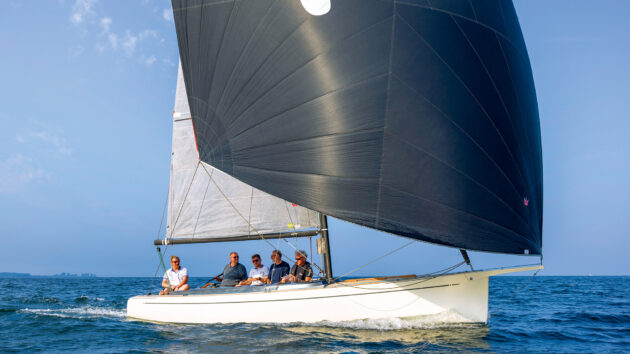
Tofinou, a long term specialist in daysailing, has continued its spirit and neoclassic style of the 9.7 with this 7.9. Now the smallest in its range, it’s very much a pure design with modern lines designed for the pleasure of a few hours warm weather sailing.
The standard boat comes engineless. You can choose a 20hp diesel, or ours had a Temo 3kW electric drive with 1.7kW batteries (€13,000 extra). My favourite feature is the iroko tiller with the throttle neatly integrated into its end.
The forward benches are convertible to allow four to sit around a table, while below decks is simply a V-berth. An infused hull with PVC foam keeps weight to 1,200kg and it uses 1.7m fixed or 1.9m retractable keels with twin rudders.
The backstay-less square top main provides grunt and the 7.9 heels easily, but the helm felt relatively heavy during our trials, a bit neutral and lacking the sporty feel its looks suggest.
Sunbeam 29.1
Meanwhile Austrian yard Sunbeam has brought out another bold design in the 29.1. It calls it a ‘daysailer+’ thanks to its generous and practical interior. A swing keel (0.85-1.85m) allows for sailing on shallower lakes, while its 2.5m beam and 2.3 tonne weight enables trailering.
The heads compartment and pantry area are optional extras, built in modules to reduce the standard price. The electric 4kW drive is standard however.
Perhaps it is best suited to lakes though, as I found it tender and uncomfortable to sail in the testing conditions we had off Kiel. In sharp waves and a Force 4-5 it heeled steeply even with two reefs. The benches are too far apart for the helmsman to brace to windward and the open transom felt unnerving. In short, it’s a clever-looking design but for calmer waters (I noted as the Bay Cruiser was having a blast nearby!)
Best specialist yacht 2024 – Saffier SE 24 Lite
Surely the hardest task is to exemplify the very best of what you do within the smallest model you can? Yet that is what today’s king of daysailers Saffier has achieved with its Se 24 Lite. And it’s enough to secure a fifth EYOTY award for this Dutch yard.
Modern hull shape, with flat underwater sections (particularly aft) combines with high form stability for a fast ride. A reverse bow brings more volume (and waterline length), while chines provide the rigidity for less weight. The result is easy speeds and addictive sailing, whether harnessing the lightest puffs or in full double digit planing mode in the stronger stuff. The distinctly low freeboard may mean there’s little in terms of ‘what’s below’, but it’s worth it for the dinghy-like sailing experience.
A simple boat to manage, whether rigging, sailing, or maintaining, the Se 24 is also very smart – including being an electrically driven boat which uses a single 24V system, charged via solar integrated into the deck. The instruments are all wireless, while a single point lift makes launching easy.
Like the very best yachts, the Saffier Se 24 Lite looks good, is a joy to sail and puts a grin on your face.
Cape Cod 767
The Cape Cod 767 is just the kind of delightful niche French daysailer the EYOTY programme helps uncover. It’s a 25ft modern trailable dayboat packed with fresh thinking, yet from a traditional Bordeaux yard which builds classic style craft.
Innovative features include the kick up rudder, a retractable mechanism for the electric drive, a pop up cockpit table, and folding backrests – it’s like something from a Transformers movie. And there are neat details such as removable Seasmart deck fittings for attaching fenders etc, even a cup holder in the tiller. It can also beach easily thanks to a 350kg hydraulic lift keel, which raises up from 1.8m in 20 seconds.
Beneath the sun bed on the flush foredeck is a V-berth for two, which helps explain the full sections forward. But the reverse bow also helps provide enjoyable sailing, whether short-tacking or gennaker reaching. Reactive and sporty, it lacks some security under sail and on deck, but the Cape Cod is a fun dayboat which offers space and comfort at anchor.
Pointer 30
The Pointer 30 is a more authentic-style daysailer from a specialist Dutch yard which has built over 2,000 open dayboats in its 70 years. It wanted a high quality, attractive yacht with a large cockpit and good sailing capabilities. This is achieved in a shape which goes well to weather, while there’s also space below decks for a proper toilet, a V-berth and quarter berths for overnighting. This interior, with its wonderful revolving chairs, fridge and chart table, helps give it a small yacht feel.
The Pointer sails as it looks – modest and handsome – and is easily managed from the deep, sheltered, long cockpit. The standard boat comes with tiller, an L-shape keel and double rudder for shoal draught. Two large 48V lithium batteries can give four hours motoring at 4.5 knots with an optional Torqeedo, or a Yanmar diesel can be chosen.

Flaar 24
Two interesting new specialist small race boats, aimed at totally different markets and waters, include the Sun Fast and the Flaar 24. The Flaar 24 is a lightweight carbon composite one-design sportsboat (750kg), with a bulb-less lift keel for lake sailing and racing. There are four berths within a bright interior with seated headroom and a chemical toilet.
Easy to launch and trailable, it’s a high-powered, slippery design with plenty of sail area. A carbon mast rigged with diamond shrouds, a large genoa and long extendable bowsprit all help boost performance.
Quick to plane, it’ll be a blast on flat water. That said, we found it quite tender and easy to overpower at sea, with a slightly cramped cockpit. Reasonable value for its carbon build, it includes a smart electric actuator which raises the keel at the push of a button, while the transom-hung rudders can be raised and locked at the height of the lifted keel.
Sun Fast 30
Much has already been said about the Sun Fast 30 (YW December), an ambitious project which aims to make offshore sailing more fun, accessible and sustainable. Of those key targets it’s the latter I found most interesting.
The Beneteau Group did impressive research into the use of Arkema’s thermoplastic resin (which has similar properties to polyester) as a more sustainable material because it can be separated from the fibre after use and reused. The result is the first production yacht built from recyclable composite materials. The hull is monolithic, the deck infused sandwich using PET foam.
The group’s strong knowledge of Figaro one-design builds and weight management, together with that of builder Multiplast, is telling. On the water this is a super playful, reactive lightweight racer, which goes surprisingly well upwind (for its scow shape) and is, naturally, very well set up for short-handing. The mainsheet and traveller are to hand of the tiller, you can clutch off the runners, cleat off the sheets and cross-sheet most lines.
The offset companionway creates space for a pit winch (note singular winch though) and there’s plenty of grip in the cockpit and on the foredeck. The minimalist interior simply includes pipe cots, a head, small sink and large chart table. It’s also spacious with 1.9m headroom.
A strict one design rule helps cap spending, banning the likes of laminate/3Di sails. However, typically this will cost €200,000 ready to sail – and while not what we might consider affordable, it’s an enticing offshore-ready one-design package (that’s around €100,000 less than the SF3300 for example).
Shogun 43
Conversely, affordability is not what the Shogun 43 is about, but what a fascinating and cool project this is nonetheless! The young Oscar Södergren’s design is a fast cruiser created for short-handed sailing but that can race fully crewed. Built by Linjett, the long established family yard which won an EYOTY award last year for its own cruising yacht, it is ‘free of rules and budget constraints’ – which translates to high-end spicy fun.
It is deliberately sleek, narrow and lightweight for short-handing, and feels it below decks, despite the three-cabin layout. But the open plan design is inviting and clever, made possible by a very stiff hull structure, with deck join at the coachroof line. This results in a rigid shell, with less dependency on bulkheads, and no unnecessary weight.
The timber clad flax fibre interior has a Divinycell core, with carbon used for structural parts (the interior only weighs around 350kg of the yacht’s 6.5 tonnes). The hull, deck, rudders and even keel blade are also all carbon – the latter you could lift by hand, even though it’s 2.7m and carries a 3-tonne bulb!
The mast is stepped far aft, behind the keel, allowing for a large self tacking jib and staysails. The test boat had the full hydraulic package, including mast deflector. On the water it proved really sporty. I like the deck layout, in particular the Karver winches for grinding in sheets and backstays, while a 2-speed high powered Seldén prototype winch on the coachroof manages the halyards. Definitely one to view… look out for more on the Shogun soon.
Best specialist yachts 2023

Best specialist yacht 2023 – Ecoracer 25
Behold a reusable, recyclable competitive sportsboat. If a ‘garage project’ such as this can successfully prove the use of more sustainable materials, such as thermoplastic resins, linen fibre, basalt and recyclable carbon are a viable solution for boatbuilding, there’s no excuse why mainstream production yards shouldn’t already be employing them!
While most fibre-reinforced boats are destined for landfill, here the composites can be separated from the resin after immersion in a solvent, to make reusable composite products. Even the 4T Forte OneSails are recyclable.
It’s the product of a group of friends who trialled the techniques and materials by first building an Optimist. Matteo Polli drew these sportsboat lines for them and a year later they were exhibiting at the Genoa Boat Show.
This is an on-trend one-off racer, which at 1.1 tonnes and 2.7m beam can be towed when tilted and takes one hour from crane to sailing. It’s so much fun to sail, even in the lightest puffs, and won the ORC sportsboat class on Lake Garda on its debut season. A shame it’s only a prototype, but the future looks bigger and brighter for this startup brand Northern Light Composites, with a 30ft version going into production.
Ace 30 plywood IRC racer
The Ace 30 may look a little uneasy on the eye to many, however others (including Fireball sailors perhaps) will be drawn to its purposeful lines, stiff construction and innovation. This is the first scow for IRC racing and short-handed events. It’s also a blast to sail, a 2.7 tonne lightweight flyer, which boasts rapid acceleration.
Curves and contours are worked into the scow bow to help reduce slamming and provide rigidity to the bow sections. It has a very stable hull shape powered by a raked carbon rig, which, when in 15+ knots wind (cue full planing), is faster than its competitors, says designer and La Rochelle builder Antoine Mainfray. We found the trick is not to pinch upwind and sacrifice a bit of angle, where it maintains high average speeds.
The Ace has a low IRC rating and is really well set up for trimming. A neat feature is the canting chart plotter screen, mounted on a long arm so it can be swung to comfortable angled seats either side. We also appreciate the eco-focussed construction, which involves a plywood epoxy shell, foam core from recycled PET and laminations in bio-sourced resin. It’s all wonderfully French but not cheap (see our January issue for more).
Astus 22.5 trailerable trimaran
For those after easy sailing and easy speeds, a trailable trimaran can be a cost effective solution for daysailing and weekend cruising. VPLP has given the Astus 22.5 a modern look with go-faster wave-piercing floats. An infusion hull and lightweight manual centreboard makes for a light boat at 800kg including engine, while two people can rig and launch it in two hours.
The Astus is sporty yet simple, offering easy planing. It has a double berth, camping stove and chemical toilet, but it’s a little cramped and basic with no real comfort for the price.
 If you enjoyed this….
Yachting World is the world’s leading magazine for bluewater cruisers and offshore sailors. Every month we have inspirational adventures and practical features to help you realise your sailing dreams.Build your knowledge with a subscription delivered to your door. See our latest offers and save at least 30% off the cover price.
The post The Best Specialist Yachts 2026: Impressive daysailers and sportsboats appeared first on Yachting World.