When upgrading stays and standing rigging do you choose wire or HMPE? And where might it pay to replace stainless steel with Dyneema? Bruce Jacobs reports

A thousand miles from anywhere in the Atlantic, with the trades blowing hard and the boat surfing down lumpy seas, the last thing you want to find on a morning rig check is a shroud that has been sawn a quarter of the way through overnight.
That is exactly what greeted us back in 2023. When not in use, we pull our running backstays forward and tie them off at the shrouds.
At some point in the night, one worked loose by no more than an inch and quietly started sawing through the leeward shroud. We were fortunate. The shroud was unloaded and we overspec our rigs to make them as close to bulletproof as possible. Even so, it was a real reminder of how quickly the sea can spring a surprise.
We had been thinking about switching some of our rigging to Dyneema for some time. The appeal is obvious. Lower weight aloft, zero corrosion, kinder on sails and spreaders and a generally more forgiving material. This incident finally gave us the push we needed to sit down and work out a sensible approach.
Rigging is one of sailing’s darker arts, so we leaned heavily on Ian Burton from Argyll Yacht Rigger, one of the UK’s real specialists in this field, to help us make a decision. What follows is our layman’s, plain English guide to investigations and ultimate conclusions on where Dyneema and wire work best for our cruising yachts.
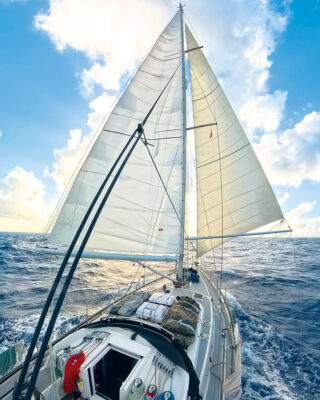
Running backstay of Dyneema is lighter and more forgiving than stainless steel wire. Photo: Rubicon 3 Adventure
Dyneema is not all about breaking loads
Dyneema slowly and permanently elongates under constant load. This means that to retain its characteristics on rigging in use for several years, you must significantly oversize it. An 8mm wire stay typically requires a 12–13mm HMPE (High Modulus Polyethylene – of which Dyneema is a type) stay to achieve equivalent stiffness.
Our biggest misunderstanding was to have focused purely on breaking load, when actually, it’s cross-sectional area that is equally important. This is also why only heat-set HMPE, such as Dynice Dux, is suitable for structural stays. Heat setting aligns the fibres under tension and dramatically reduces creep.
Article continues below…
Dyneema will likely be more expensive
At first glance, Dyneema often appears to be cheaper than wire. The increase in size from 8mm wire to 12mm Dyneema quickly eliminates some of the upfront savings, and these are likely then removed entirely when the increased labour is factored in.
HMPE of any variety requires expert splicing with a correct bury, teardrop taper, careful stitching and chafe covers. It is a far more time-consuming job than swaging or fitting a mechanical terminal. Unless you are a (genuinely) competent splicer, the final labour bill for HMPE will typically be 20% to 40% higher than for stainless steel wire.
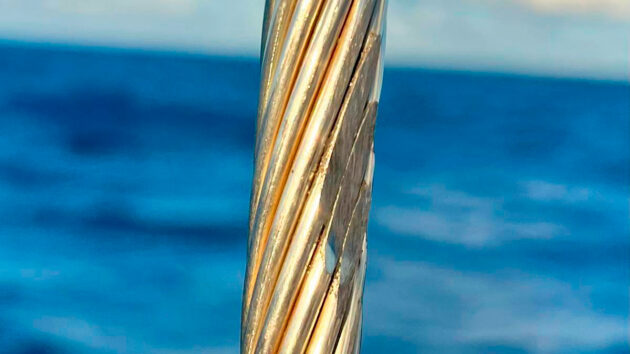
Stainless steel shroud worn overnight by chafe from a loose running backstay. Photo: Rubicon 3/Argyll Rigger
The real advantages of Dyneema
Used in the right places, Dyneema is fantastic. The most obvious benefit is weight. Replacing wire with Dyneema typically removes around 80% of the weight aloft, which will have a direct and noticeable effect on pitching and rolling at sea. It also brings the significant advantage of having no corrosion. There are no swage cracks to worry about, no electrolytic pitting in hot climates and no broken wires at terminals waiting to catch you out.
Dyneema is quiet, easy on sails and spreaders and generally much more forgiving of contact with the rest of the yacht. It is also far easier to handle than wire, being light and easy to coil.
The trade-offs
However, Dyneema, comes with its own set of issues. UV exposure is one of these. There is no universal lifespan figure because so much depends on colour, coatings, jackets and the climate in which the boat sails.
A dark, UV-stable rope used in northern Europe will have an entirely different lifespan from a pale, lightly protected line sitting under the Caribbean sun.
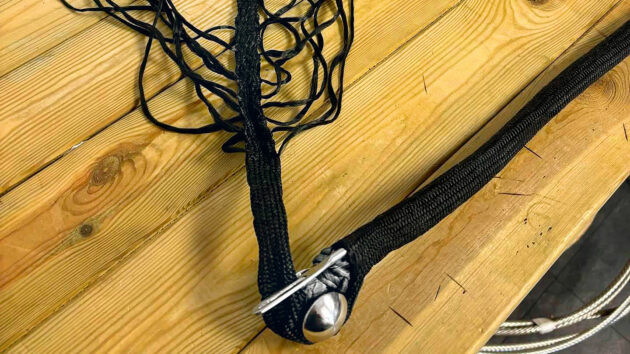
A special bone-shaped fitting has to be expertly spliced into the end of the Dyneema line. Photo: Rubicon 3/Argyll Rigger
Possibly more of an impact than UV is internal abrasion, not least as this is the damage you can’t easily see. Every time the rig moves, the fibres inside the rope rub against one another and gently wear. Any fine grit or salt crystals inside accelerate the wear. It is this internal degradation that is often the limiting factor in lifespan as much as UV.
External chafe is another challenge. Where wire is impervious to most contact, HMPE hates sharp or rough edges or nicks from passing tools or stores. Dyneema also melts at a very low temperature of 100°C (Polyester rope melts at about 260°C). This means sustained friction from a flogging sheet or a fast-moving rope could melt it and cut through it in seconds. For this reason, any point where the line might rub needs proper sleeving or sacrificial protection. Even the radius and entry angle through blocks and thimbles affect its longevity; forcing HMPE around a small or sharp radius dramatically shortens its life.
Taking all these variables into account, we calculated that we will have the same replacement schedule for Dyneema as we do for wire. As our business involves commercial yachts being used in remote conditions and heavy weather, this means four years or 40,000 miles. For private cruising yachts, an increase to five to eight years is probably prudent, although clearly many rigs are not replaced for up to 10 years or more.
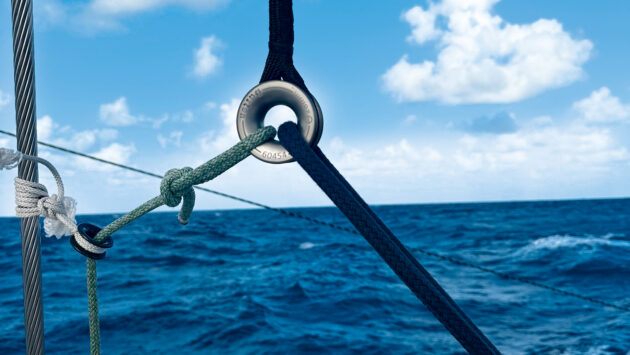
Thimbles help secure Dyneema running rigging out of harm’s way when not in use. Photo: Rubicon 3/Argyll Rigger
Where Dyneema excels
There are areas where we concluded Dyneema is unquestionably the better solution, and our running backstays were one of them. The difference in weight and handling was immediately transformative. They are significantly lighter and easier to handle, and they don’t damage everything they brush against. We have fixed inner forestays and babystays, but for yachts with removable inner forestays for a storm jib or staysail, replacing wire with HMPE would likely be another perfect use case. A Dyneema forestay weighs almost nothing, is easy to store and avoids the clanging and damage that a wire stay causes when not under load.
Finally, a strop for something such as a Code 0 would also likely benefit greatly in light winds from the reduced sag and improved furling performance that would come from Dyneema’s very low weight. It is in these specific applications that Dyneema offers practical, tangible benefits, making replacing wire a sensible choice.
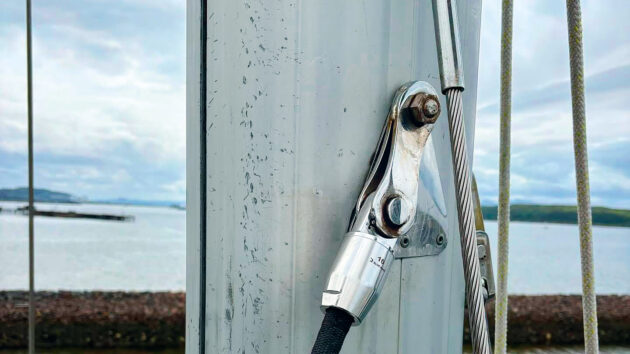
The Dyneema rope ball terminal in situ at the running backstay attachment point on the mast. Photo: Rubicon 3/Argyll Rigger
Where wire still wins
Despite Dyneema’s many strengths, we concluded with Burton that stainless steel remains the best choice for the primary shrouds and forestays of most cruising yachts. Wire is predictable, easy to inspect and replaceable worldwide. The small performance gains from weight savings aloft would rarely outweigh such practical realities for cruising sailors.
Likewise, if a stay or shroud fails mid-ocean, the immediate response is always the same regardless of the material. You stabilise the mast with a halyard as fast as you can and head for land. However, once ashore, you’ll likely get moving again far more quickly and easily with wire than Dyneema, which would mean sourcing specialist materials and waiting for someone who can splice it correctly. This is the main reason none of the high-latitude or round-the-world training yachts Argyll Yacht Rigger has dealt with have switched their primary standing rigging to fibre.
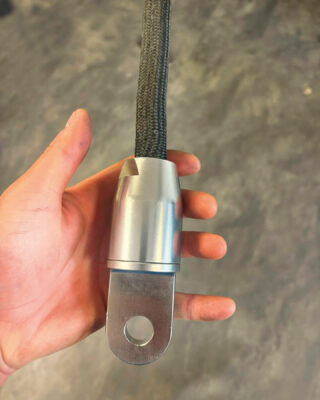
An eye fitting is screwed into the housing and
secured with Loctite to complete the terminal. Photo: Rubicon 3/Argyll Rigger
Quality is everything
If there’s one lesson from all this, it is that with structural HMPE, there is no margin for error. A poor splice is a potentially rig-ending failure waiting to happen. A too-short bury, a badly tapered tail, poor stitching, or an incorrect entry angle can significantly reduce its strength.
The wrong diameter may have the correct breaking load, but will still stretch too much. It means this is not an area to try to save on materials or labour, and any decision between wire and Dyneema should assume from the outset that Dyneema will cost more.
Our conclusion
After many hours discussing the pros and cons with Burton, we only replaced our running backstays with Dyneema, adding custom chafe sleeves. We already use Dyneema for strops. Everything else remained stainless steel. Six months and 24,000 miles later, we are certain that this was the right mix.
Dyneema is a brilliant material, but it is not a universal upgrade. For your yacht, use it sensibly, respect its limitations and have it installed by someone who truly understands it.
 If you enjoyed this….
Yachting World is the world’s leading magazine for bluewater cruisers and offshore sailors. Every month we have inspirational adventures and practical features to help you realise your sailing dreams.Build your knowledge with a subscription delivered to your door. See our latest offers and save at least 30% off the cover price.
Note: We may earn a commission when you buy through links on our site, at no extra cost to you. This doesn’t affect our editorial independence.
The post Dyneema vs. Wire: How to pick the right standing rigging for your yacht appeared first on Yachting World.