Nikki Henderson explores why a clear pathway, not a lack of interest, is the key to solving sailing’s ageing problem
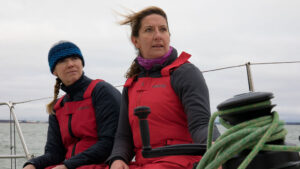
Recently I was in Cowes for a weekend with RORC’s 2026 Griffin squad. The RORC scheme offers 30 young adults under 30 years old an opportunity to race offshore on its Sunfast 3600. This year, the most experienced team will be racing in the Round Britain and Ireland race.
Sailing has an ageing problem if you look at statistics for club membership and boat owners. Yet 300 sailors applied to the Griffin 2026 selection rounds, half of them female. There’s no shortage of younger sailors – they just need a pathway in. It was a British February weekend, pouring with rain, blowing 20+ knots, and every single one seemed excited to get out on the water.
On the Saturday evening, Shirley Robertson OBE gave an emotive talk about racing the 2022 Round Britain and Ireland with Dee Caffari on their Sun Fast 3300 RockIT. That year the race was relentless, almost entirely upwind for the smaller boats and a long, slow 14-days.
Shirley brought to life the brutality of two weeks at sea on a small boat. The struggle to pull off her foulies and get into bed just for a meagre 40 minutes rest – and the hallucinations that followed if she didn’t. She drew the audience’s attention to the discipline an offshore race like that demands – everything from complex coastal navigation to rubbish management and keeping the boat hygienic. “There’s just so much to think about,” was her mantra throughout the evening.
What’s more, while Shirley’s Olympic sailing career had involved focussing on fine details for decades, Dee’s offshore sailing ‘big picture’ approach meant they had to start from scratch to find a way of communicating.
When Shirley finished, the room was wide eyed. It was a proper wake up call.
“Now we’re really nervous,” one of the crew said to me. “We’ve just realised how cold it’s going to be. We’re going to have to figure out our kit.”
Heroic tales of big waves and storms are what tend to classify hard core sailors. We give more credibility to sailors who’ve seen big conditions. But life down below is often harder than life on deck. Sometimes the real concerns are domestic. Not ‘how big were the waves?’ but ‘how cold were your hands – and how did you cope?’
Article continues below…
I have haunting memories of my first transatlantic race I skippered. It was supposed to be a lush 3,000-mile tropical downwind race. Instead we started with eight consecutive days of upwind bashing and rain. I was 20, inexperienced and had very little money. So I made sub-par routing choices, and brought not quite the right clothing with me. Despite all the challenges I faced, it was the moment where I slid my arm into the damp, clammy sleeve of my now not-at-all-waterproof jacket where I hit my wall. There is just something so indescribably draining about being wet and not having a break from it.
The wrong clothing can break people faster than big conditions. I’ve seen grown men shed tears after finding their glove soaking wet in the bilge. I’ve seen people so exhausted at the prospect of having to get undressed to go to bed they simply sleep in their oilskins.
And many an expletive has been shouted from even the calmest crew when seawater finds its way down their boot on the rail, or worse, down the neck seal of an otherwise dry top.
Clothing isn’t just about preserving morale, it’s a safety topic. Being cold can stop your brain working and render you useless for decision making. Being too hot is a common cause of seasickness. Wearing too many layers makes moving around awkward and risks injury. Frozen hands can’t undo knots, or operate safety tether clips.
Taking time to source good clothing is as much about performance and seamanship as it is vanity. Which is why I think we should treat acquiring and packing kit as a critical preparation job, like tensioning the rig or downloading weather. And not to do what I always seem to – which is leave it to the very last minute, shove it all in the smallest bag I can get away with, and hope for the best.
My priority number one is always staying dry. These days I never go sailing, irrespective of the climate, without my smock with latex neck and cuff seals. My second priority is wearing clothing I like. After years of packing technical or team clothing I realised that comfortable gear that leaves me feeling good at sea is really important and makes me perform better.
 If you enjoyed this….
Yachting World is the world’s leading magazine for bluewater cruisers and offshore sailors. Every month we have inspirational adventures and practical features to help you realise your sailing dreams.Build your knowledge with a subscription delivered to your door. See our latest offers and save at least 30% off the cover price.
Note: We may earn a commission when you buy through links on our site, at no extra cost to you. This doesn’t affect our editorial independence.
The post Learning lessons from Shirley Robertson and Dee Caffari – Nikki Henderson appeared first on Yachting World.